Showing posts with label Google Assistant. Show all posts

Thursday, February 9, 2017

Google launches Android Wear 2.0, an evolutionary upgrade to the smartwatch OS

Google launches Android Wear 2.0, an evolutionary upgrade to the smartwatch OS

Image Credit: Google
By 
Google has launched Android Wear 2.0, the newest version that will power smartwatches. The upgrade was announced last year during Google I/O 2016 and the update is a few months late than what was originally planned. The company has not made any revolutionary changes to the smartwatch experience to change how we look at smartwatches. Instead, the company has added updates to many key components of the operating system which will enable faster access to the things that you performed on your Android Wear-powered smartwatch.
Image Credit: Google Android
Android Wear 1.0 was a bit complicated and most of the operations that you wanted to perform seemed more complex than they should be. Google focused on improving this by removing the complexity. The first important change that you will se is the presence of better Watch Faces and an easier way to change Watch Faces.
Image Credit: Google
Google has changed the fundamentals of watch faces by adding space to show information from the system as well as third-party apps like Uber, Nike and other fitness or weather apps. This is done by collecting the information using the Complications API. The process to change Watch Faces is as easy as flicking left or right instead of long pressing on the screen to go to a screen where you can change the watch faces.
Image Credit: Google Android
The second most important improvement is the introduction of standalone apps that don’t need companion apps on your smartphone. You don’t need to install separate apps on your smartphone to help run the Android Wear apps. You can now access Google Play Store on the watch and install new apps without the need of a smartphone. The interface of Android Wear 2.0 is more in line with the Material design guidelines with more emphasis on cards where each notification will get a full screen for its expanded view.
Image Credit: Google
Another significant improvement is the addition of Android Pay to Android Wear 2.0. You can use your Android Wear 2.0 powered Smart watch to pay using Android Pay. One thing to note is that the smart watch should be equipped with NFC  and your smartphone must have a locked bootloader.
Image Credit: Google
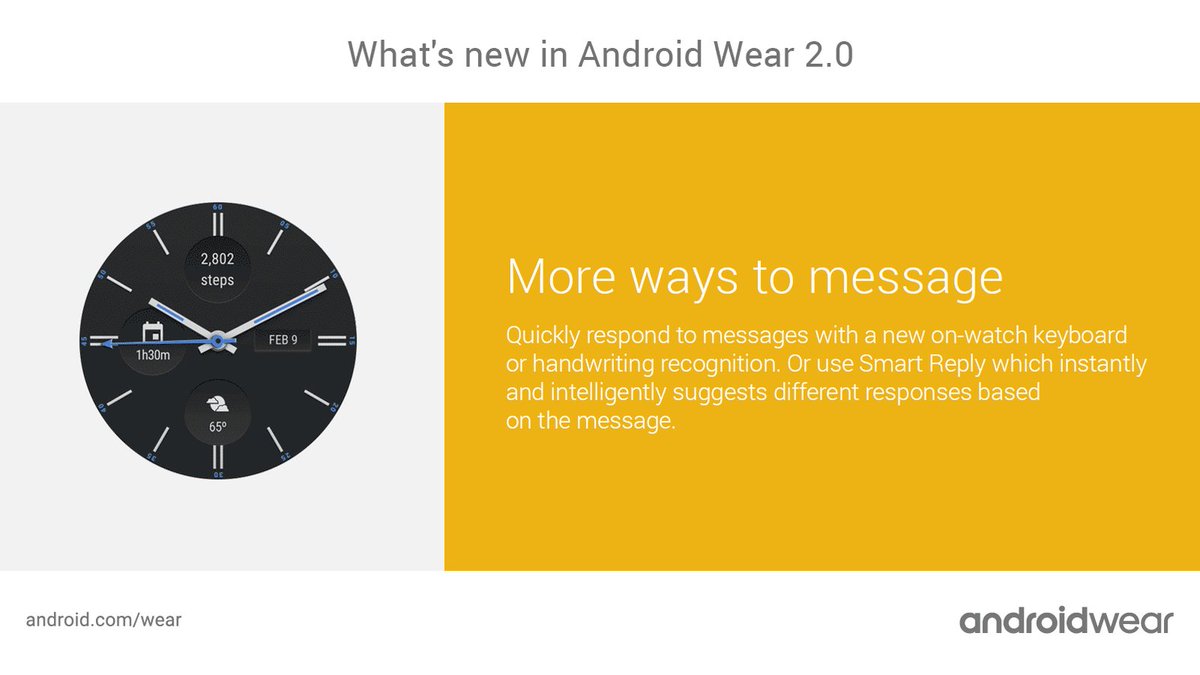
Google has improved other things like the Google Fit app for Google Android Wear where it now supports more type of workouts and exercises. One interesting thing to note is that Android Wear 2.0 comes with a keyboard to type your responses on. One would obviously not use that keyboard to write long articles or something huge in size. The major thing that makes the keyboard on Android Wear 2.0 significant is that you no longer need to swipe across a Qwerty layout screen to type a message. Instead, the keyboard is powered using the powerful prediction engine of Google Keyboard which works surprisingly well. You can also handwrite messages or use smart reply for Google Assistant.
Last but not the least, Google has added Google Assistant to Android Wear 2.0 making it a significant improvement over Android Wear 1.0 and Google Now. This is almost like Google Assistant on Google Home or Google Pixel smartphone. One thing to note is that Google has changed its philosophy after realising that one does need some physical input to operate Android Wear, making the presence of buttons and dials mandatory on the new models of watches; a far cry from what it was earlier.

Monday, January 9, 2017

Nokia’s ‘Viki’ digital assistant will take on Google Assistant, Siri and Alexa in the near future

Nokia’s ‘Viki’ digital assistant will take on Google Assistant, Siri and Alexa in the near future

Image: Weibo
By 
It certainly looks like the future of the smartphone is the digital assistant. The space is currently ruled by Google Now and Siri. Alexa and Cortana aren’t far behind either. Joining the fray, possibly, is Nokia’s own assistant and this one’s called Viki.
Google Assistant is an evolution of Google Now, but isn’t available on many devices yet.
GSMInfo.nl spotted Viki in a trademark filing made by Nokia. The trademark application was for the name Viki, and describes a software for “the creation and monitoring of mobile and web assistants working with digital knowledge and combining all data sources into a single chat and voice-based interface.”
Nokia, which recently revived its brand with the launch of the Android powered Nokia 6 in China, seems to have its heart in the right place. Samsung is also aware of the impending, AI-powered future and has been working on its own digital assistants for a while now (dubbed Bixby and Kestra).
As far as we’re aware, Viki is still only a name on a trademark application and we don’t even know the work that has been done on this AI.
There is also no timeline on if and when Viki will make its way to Nokia’s devices.

Friday, January 6, 2017

CES 2017: Nvidia launched Shield TV with Google Assistant and Nvidia Spot AI Mic

CES 2017: Nvidia launched Shield TV with Google Assistant and Nvidia Spot AI Mic

Image Credit: Nvidia
By 
Nvidia has launched a new Nvidia Shield TV at CES 2017 in Las Vegas. The company claims that new Shield TV will deliver unmatched performance in providing experiences like gaming, streaming and AI integration. The company has integrated Google Assistant for TV in addition to bringing a new design to Shield TV. Nvidia has opened Shield TV for pre-order and will start shipping to United States, Canada and selected regions in Europe later this month.
The device is priced at $199.99, and it will now ship with Gaming controller and remote, and you no longer need to buy them separately. Nvidia Shield Pro will also be available later this month with the controller, remote, headphone jack and 500GB storage. One interesting thing is that the company will ship a separate version of Shield TV with custom software to China later this year.
Image Credit: Nvidia
Shield adds support to 4K HDR streaming while providing three times the performance to what other media streaming devices provide in the market. It will provide support to video streaming apps from Netflix, YouTube, Google Play Movies and VUDU. YouTube TV app is set to come to the new Shield devices in coming months. Jen-Hsun Huang, founder and CEO of Nvidia added, “NVIDIA’s rich heritage in visual computing and deep learning has enabled us to create this revolutionary device.”
Shield TV is not limited to being a media streaming devices, and the company highlighted that the Shield Library of games has expanded to thousands of titles along with the ability to stream Ubisoft games like Watch Dogs 2, Assassin’s Creed Syndicate, For Honor and others. New Ubisoft games will be available for Shield TV owners along with the launch of their PC releases. Highlighting the AI capabilities of the new device he further adds that “SHIELD’s new AI home capability, we can control and interact with content through the magic of artificial intelligence from anywhere in the house.”
Image Credit: Nvidia
Shield TV will provide the first hands-free Google Assistant integration on TV and Google has optimised the experience to work on large screens. In addition to streaming, gaming and AI, Nvidia has also added the support for Shield TV users to turn the device into a smart home hub which can be used to connect to hundreds of smart connected devices at home and control them. Nvidia Spot is one interesting add-on to Shield TV as it makes the device, the backbone of the AI home with improved control throughout the house.

Monday, October 31, 2016

Google Pixel: Company wants to make voice-powered Assistant better than rivals Siri and Cortana

Google Pixel: Company wants to make voice-powered Assistant better than rivals Siri and Cortana

About six months ago, people working on hardware and the voice-activated Google Assistant for the Pixel phone started sitting next to each other at the company’s Mountain View, California headquarters, hammering out minute details of its first phone.
The new seating arrangement illustrated a much larger shift underway at Alphabet Inc’s Google, which crashed Apple Inc’s smartphone revolution eight years ago by giving away its Android software and letting handset makers do the rest.
Google software now runs on 85 percent of the world’s smartphones, but as voice control threatens to replace touch as the primary means of using a hand-held device, the company is experimenting with a different approach – more akin to Apple’s tight integration of hardware and software.
The Pixel’s hardware and Assistant teams gather for happy hour every Friday and have already received a prototype for the camera on next year’s phone, said Brian Rakowski, vice president of product for Google’s Android operating system.
Their ambition: to make the company’s voice-powered digital assistant better than rivals such as Apple’s Siri and Microsoft Corp’s Cortana.
“We really wanted the Assistant on the phone to feel like a natural extension of the ways you ask Google for information,” Rakowski said in an interview.
LEAF FROM APPLE’S BOOK
The fusion of hardware and software is key to that goal. Certain specifications are crucial for a high-performing assistant, such as a well-placed microphone and a powerful processor to crunch reams of data.
Creating an app isn’t enough; that requires a few clicks for users to get to it.
The hardware and software teams worked closely on details such as the graphics that appear when users call up the assistant, settling on a flurry of colorful dots, which Rakowski called a “whimsical touch to give a little bit of life to the home button.”
The Assistant is always at the ready on the Pixel phone and can be summoned by pressing the home button or saying the words “OK Google.”
By integrating the Assistant into the Pixel, Google “doesn’t have to do negotiations with another handset maker – they can make it as tight as they want,” said Charles Jolley, chief executive of Ozlo, which offers a digital assistant by the same name.
To make sure users get the best possible experience, the Assistant will live only on Google products such as the Pixel, at least for now.
In the long term, however, it is unclear whether Google will keep it that way, or return to its original phone strategy and try to push the product out to the millions of smartphones running on other manufacturers’ Android phones, at the risk of offering a slightly lower-quality experience.
Rakowski said making sure the Assistant works well on other phones would require a close level of integration with handset makers, beyond the typical work that happens on the Android operating system.
“We want all these features of the Assistant to work well and work quickly and be nicely integrated so it gives the right idea of what the Assistant can do,” he said “We don’t want it to feel limited or bolted on in any way.”
He admits it could be challenging to execute the Assistant on some current Android phones.
“You can’t do some of the always-on ‘OK Google’ detection on some phones because they don’t include the right hardware to do that,” he

Thursday, October 6, 2016

Many Android 7.1 Nougat features, including Google Assistant, are exclusive to the Pixel


By Rob Thubron on October 6, 2016, 8:30 AM


Google finally unveiled its long-rumored Pixel smartphones earlier this week. They will be the first to launch with Android 7.1 Nougat, but many of the Pixels’ best features, such as the new Google Assistant, won’t appear on other Android devices, including Google’s own Nexus series, when the OS arrives.

An Android 7.1 Nougat changelog leaked to Android Police shows which new features will appear in the upcoming operating system, as well as those that are Pixel-only. Google confirmed that the information is accurate is to TechCrunch.

The absence of the AI-powered helper will come as disappointment to those who expected to see the Siri/Cortana/Alexa rival on every handset receiving Android 7.1 Nougat. Google Assistant is essentially a more advanced version of Google Now, able to engage in two-way conversations with users, perform complex tasks, and learn and recall personal information from previous conversations for context.

Other Pixel exclusives include the free, unlimited photo and video (in their original quality) cloud backup service; the smart storage feature, which automatically removes old, backed up images/videos when the storage is full; and the Pixel Camera and Launcher apps. 24-hour phone/chat support and screen-share functionality will also be limited to the Pixel phones.

There are some interesting new features coming to all devices that receive Android 7.1, though. There’s the Night Light blue filter, which changes the color temperature of a display at night. A Daydream VR mode is also on its way, along with support for sliding down on the fingerprint sensor to open the notification bar.

Google did say that its Assistant would eventually be arriving on other Android devices, just don’t expect it soon. Ultimately, the company will likely replace Google Now with its more advanced version of the assistant.

"Our goal is to make the Google Assistant widely available to users, and we’ll continue to launch new surfaces over the course of the next year," a Google spokesperson told TechCrunch.

The developer preview of Android 7.1 arrives later this month. Google hasn’t said when it will come to phones other than the Pixel.

Tuesday, October 4, 2016

Google Event: You can expect hardware, AI and VR announcements today

Google Event: You can expect hardware, AI and VR announcements today

By 
Google’s big October event is just hours away, and there are expected to be a number of major announcements. We might be on the verge of an extraordinary push into Hardware by Google, especially considering the event url is called Made by Google. The biggest announcement is expected to be the launch of two new high end Android handsets, that will let Google compete directly with Apple. There are further announcements expected for Google Home, Allo, the Daydream platform, and Chromecast. This is going to be an exciting confluence of hardware, artificial intelligence and virtual reality.
Pixel and Pixel XLThere were reports as far back as June that Google was in talks with hardware manufacturers to release in house devices. Two new smartphones from Google are expected to be launched at the event, and they seem to be positioned as the direct competition to the Apple iPhone 7 and the Apple iPhone 7 Plus. They are premium smartphones, with high end specifications, with custom software, and Google Assistant baked right in, to take on Siri. The Pixel phones are expected to come with unlimited cloud storage for photos and videos, that too in the original resolution. This is an attractive feature that will heavily convenience users, as they can easily forget about managing photos and let Google do all the hard work.
Google Pixel launch Made by Google
The Pixel Xl and the Pixel
The Pixel reportedly sports a 5.2-inch screen, whereas the slightly larger Pixel XL is expected to have a 5.5-inch  screen. Google finally stepping in to take on Apple products, comes towards the end of a year with a number of premium smartphones launches, including the OnePlus 3LG G5Huawei P9the Samsung Galaxy S7 and S7 Edge, and the Samsung Galaxy Note 7. While still a niche category in India, there is
Related Posts Plugin for WordPress, Blogger...