Showing posts with label Apps. Show all posts

Tuesday, April 4, 2017

Apps on your smartphone could be talking to teach other and breaching your privacy: Study

Apps on your smartphone could be talking to teach other and breaching your privacy: Study

Do you use smartphone apps to organise lunch dates, make convenient online purchases or communicate the most intimate details of your existence? Beware, these apps may be secretly talking to each other and potentially breaching your security, researchers warn.
A study showed that applications on the android phones are able to talk to one another and trade information. The biggest security risks were some of the least utilitarian — apps that pertained to personalisation of ringtones, widgets, and emojis, the researchers said. “Researchers were aware that apps may talk to one another in some way, shape, or form,” said Gang Wang, assistant professor at Virginia Polytechnic Institute and State University, US.
But “this study shows undeniably with real-world evidence over and over again is that app behaviour, whether it is intentional or not, can pose a security breach depending on the kinds of apps you have on your phone”, Wang added. The types of threats fall into two major categories, either a malware app that is specifically designed to launch a cyber-attack or apps that simply allow for collusion and privilege escalation.
In the latter category, it is not possible to quantify the intention of the developer, so collusion, while still a security breach, can in many cases be unintentional, the researchers said. The findings were presented at the Association for Computing Machinery Asia Computer and Communications Security Conference in Dubai.
The team examined a whopping 110,150 apps over three years including 100,206 of Google Play’s most popular apps and 9,994 malware apps from Virus Share a private collection of malware app samples. “Of the apps we studied, we found thousands of pairs of apps that could potentially leak sensitive phone or personal information and allow unauthorised apps to gain access to privileged data,” commented Daphne Yao, associate professor at Virginia Tech.
“We hope this study will be a source for the industry to consider re-examining their software development practices and incorporate safeguards on the front end,” Wang added.
Publish date: April 4, 2017 10:47 am| Modified date: April 4, 2017 10:47 am

Friday, March 24, 2017

Nearly 10 million Android devices have Potentially Harmful Apps says Annual Android security report

Nearly 10 million Android devices have Potentially Harmful Apps says Annual Android security report

According to the latest Android annual security report, more than 735 million devices from over 200 manufacturers have received platform security updates in 2016. The annual Android security report looks at data on Potentially Harmful Apps (PHAs) across Android devices. It also explains how the OS checks apps for unsafe behaviour and provide statistics on the state of software updates for Android devices.
If you are an Android user, you would know that Google releases monthly Android security updates and has been doing so for devices running Android 4.4.4 and up.
While half of devices at the end of 2016 did not receive a platform security update last year, the security team is working to update and streamline the program so that it is easier for manufacturers to push security updates.
android-security-report-blocked-PHA
The team also revealed that Android’s ‘Verify Apps’ feature conducted 750 million daily checks last year which is a significant update from 450 million the year before. The report also mentioned that the percentage of devices with PHAs went up in 2016 however the overall number was still low.
About 0.71 percent of all Android devices had PHAs installed at the end of 2016, which was 0.5 percent in the beginning of 2015. This means that out of the total 1.4 billion Android users nearly 10 million devices have potentially harmful applications installed.
android-security-report-blocked-PHA1
Publish date: March 23, 2017 1:37 pm| Modified date: March 23, 2017 7:32 pm

Saturday, January 14, 2017

Flurry State of the Mobile report: Social media, messaging apps usage grew by 394 percent in 2016

Flurry State of the Mobile report: Social media, messaging apps usage grew by 394 percent in 2016

By 
Flurry, an analytics platform for apps from the Yahoo Developer Network has released its annual State of the Mobile report for 2016 and has some interesting insights. Flurry has been doing this since the last eight years.
The mobile app usage has grown by 11 percent on an average with social, messaging and sports related apps showing a growth in excess of 40 percent. Flurry has tracked around 940,000 apps across 2.1 bn devices and over 3.2 trillion sessions. Flurry defines app usage as “a user opening an app and recording what we call a “session,” as well as the amount of time spent in the application.”
31415282904_2f696e78f8_z
Games, news and magazines, personalisation app categories saw a decline in terms of app usage, with music, media and entertainment showing a miniscule 1 percent rise.
The increase in the app usage of the social media and messaging apps has also led to the stupendous rise in the time spend on the these apps. Thanks to a 394 percent increase in the time spent on social and messaging apps, the average growth in time spent on apps rose by 69 percent. A lot of the credit for this goes to social media and messaging apps adding features such as voice calling as well as video calling on some.
31415282864_48be7167cc_z
Business and Finance and Sports, which are categories that are heavily time dependent, saw an increase in time spent by around 43 percent and 25 percent respectively. “We anticipate further growth in these categories as users continue to shift daily habits away from traditional media channels, i.e., watching live sports, market reports and the morning news on their TVs, to the apps on their phones,” said the report.
Gaming did not see a massive growth in 2016 thanks to the lack of popular titles. Pokemon Go was a star game of 2016 no doubt, but it also saw a consumer interest fading fast. Super Mario Run, which was released towards the end of the year, was not able to affect the overall numbers in the gaming apps. In fact, Super Mario Run, has itself been struggling to sustain the growth momentum that it had seen in the launch week.
Shopping apps saw a rise by 31 percent and according to this Adobe report, Amazon amassed 38 percent of the holiday sales transactions in the last two months of 2016.
In terms of device form factors, the phablets dominated the numbers, with Q4 2016 showing a 41 percent uptick over last year.

US court rules iPhone users can sue Apple for not allowing installation of apps outside the app store

US court rules iPhone users can sue Apple for not allowing installation of apps outside the app store

Image: AP
iPhone app purchasers may sue Apple Inc over allegations that the company monopolized the market for iPhone apps by not allowing users to purchase them outside the App Store, leading to higher prices, a U.S. appeals court ruled on Thursday. The 9th U.S. Circuit Court of Appeals ruling revives a long-simmering legal challenge originally filed in 2012 taking aim at Apple’s practice of only allowing iPhones to run apps purchased from its own App Store. A group of iPhone users sued saying the Cupertino, California, company’s practice was anticompetitive.
Apple had argued that users did not have standing to sue it because they purchased apps from developers, with Apple simply renting out space to those developers. Developers pay a cut of their revenues to Apple in exchange for the right to sell in the App Store. A lower court sided with Apple, but Judge William A. Fletcher ruled that iPhone users purchase apps directly from Apple, which gives iPhone users the right to bring a legal challenge against Apple.
Apple declined to comment. The courts have yet to address the substance of the iPhone users’ allegations; up this point, the wrangling has been over whether they have the right to sue Apple in the first place.
But if the challenge ultimately succeeds, “the obvious solution is to compel Apple to let people shop for applications wherever they want, which would open the market and help lower prices,” Mark C. Rifkin, an attorney with Wolf Haldenstein Adler Freeman & Herz representing the group of iPhone users, told Reuters in an interview. “The other alternative is for Apple to pay people damages for the higher than competitive prices they’ve had to pay historically because Apple has utilized its monopoly.”
The case is Pepper et al v. Apple Inc., case number 4:11-cv-06714 in the U.S. District Court for the Northern District of California.
Reuters

Friday, November 4, 2016

Google is improving Play Store with AI powered recommendations and more payment models

Google is improving Play Store with AI powered recommendations and more payment models

Alphabet Inc’s Google is redoubling efforts to help developers of Android mobile apps build their businesses as concerns mount that the app economy has reached saturation. Under the leadership of Sameer Samat, who rejoined Google earlier this year after a spell as president of wearable tech firm Jawbone, the company is sharpening Google Play store recommendations with artificial intelligence and expanding support for various payment platforms, among other initiatives.
Google’s efforts in some way mirror those of arch-rival Apple Inc, which revamped its App Store this year with quicker review times for new apps and an increase in the cut of revenue that goes to developers. Both companies face a chorus of complaints from developers who say they are struggling to stand out in a jam-packed field. Many smartphone users, meanwhile, appear to have tired of downloading apps altogether, especially as messaging services like Snapchat perform more of the functions that once required a separate app.
Games remain a focus of the Google Play store, and Nintendo Co Ltd is building a version of its popular Super Mario Run game for Android, said Samat, who leads product management for the Google Play store. The store is also expanding to new platforms, including wearable devices, virtual reality headsets and Google’s Chromebook laptops. “What we are excited about is giving developers that single entry point for more and more of the computing ecosystem,” said Samat.
Android Wild West
Google has eased the once-complicated process of developing apps for the Play store, said James Knight, a former Google employee who launched Pembroke, a consultancy that helps developers convert Apple-compatible iOS apps to the Android operating system. “The App Store has historically been a little more straightforward, and Android has been a bit more like the Wild West,” he said.
Mirroring the larger smartphone market, the Google Play store sees far more activity by virtue of its placement on the wide range of devices running the Android operating system – but Apple claims more of the profits. The Google Play store accounted for 70 percent of app downloads in the third quarter of this year, but Apple’s App Store logged 65 percent of the revenue, according to App Annie, a mobile analytics firm.
A big part of Google’s new effort involves emerging markets, where Android is stronger relative to the iPhone. The company has steadily expanded its support of direct carrier billing, a popular payment method in emerging markets where consumers often do not have credit cards. Google now offers the payment method in 47 markets. To improve app recommendations for users, the Play store has also made extensive use of machine learning, a branch of artificial intelligence that gleans insights from vast troves of data. Google’s Play store and machine learning teams began collaborating three years ago, and a partnership was struck last year with Google Brain, a cutting-edge research project.
The jolt of artificial intelligence is welcome as developers hunt for an audience for their apps, said Greg Cohn, chief executive of Burner, which makes an app that provides temporary phone numbers. “The harsh reality is that there are a few apps that get the vast majority of people’s time and attention,” he said.
Reuters

Sunday, October 16, 2016

Big data applications are 10X more complex than regular apps, and developers often need to know a plethora of technologies just to make big data work.


Image: iStockphoto/SIphotography

By Matt Asay | October 13, 2016, 8:12 AM PST


Big data is still too difficult. Despite all the hype—and there has been lots and lots of hype—most enterprises still struggle to get value from their data. This led Dresner Advisory Services to conclude, "Despite an extended period of awareness building and hype, actual deployment of big data analytics is not broadly applicable to most organizations at the present time."

Ouch.

Some of this is a people problem. However persuasive the data, executives often prefer to ignore that data. But, a big part of the complexity in big data is about the software required to grok it all. Though Spark and other, newer systems have improved the trajectory, big data infrastructure remains way too hard, a point made astutely by Jesse Anderson.
This stuff is hard

People have long loomed as one of the biggest impediments to big data adoption. A 2015 Bain & Co. survey of senior IT executives found that 59% believed their companies lack the capabilities to make sense (and business) of their data. Speaking specifically of Hadoop, Gartner analyst Nick Heudecker suggested that "Thru 2018, 70% of Hadoop deployments will not meet cost savings & revenue generation objectives due to skills & integration challenges." Skills matter, in other words, and are in short supply.


Over time the skills gap will decrease, of course, but understanding the average Hadoop deployment, for example, is non-trivial, as Anderson noted. In his words, the complexity of big data comes down to two primary factors: "you need to know 10 to 30 different technologies, just to create a big data solution," and "distributed systems are just plain hard."

The question is why.

Anderson schematically represented the complexity of a typical mobile application versus a Hadoop-backed application, noting that the latter involves double the number of "boxes," or components. Expressed in plain English, however, "The 'Hello World' of a Hadoop solution is more complicated than other domains' intermediate to advanced setups."


Compounding the difficulty, Anderson said, is the need to understand the wide array of systems involved. You might need to know 10 technologies to build a big data application, for example, but that likely requires you to have some familiarity with another 20 technologies simply to know which one to use in a given situation. Otherwise, for example, how are you going to know to use MongoDB instead of Hbase? Or Cassandra? Or neo4j?


Add to this the complexity of running it all in a distributed system, and it's no wonder that the skills shortage for big data persists.
The easy way out

One way that enterprises are trying to minimize the complexity inherent in big data build-outs is by turning to the public cloud. According to a recentDatabricks survey of Apache Spark users, deployment of Spark to the public cloud has ballooned 10% over the last year to 61% of total deployments overall. Instead of cumbersome, inflexible on-premises infrastructure, the cloud allows for flexibility and, hence, agility.


It does not, however, remove the complexity of the technologies involved. The same hard choices about this or that database or message broker remain.

Such choices, and the complexity therein, isn't going away anytime soon. Companies like Cloudera and Hortonworks have arisen to try to streamline those choices, tidying them up into stacks, but they still essentially provide tools that need to be understood in order to be useful. Amazon Web Services is going a step further with its Lambda service, which allows developers to focus on writing their application code while AWS takes care of all the underlying infrastructure.

But the next step is to pre-fab the application for the end user entirely, which is what former Wall Street analyst Peter Goldmacher dubbed a much bigger opportunity that selling infrastructure components. In his words, one major category of "winners [is] the Apps and Analytics vendors that abstract the complexity of working with very complicated underlying technologies into a user friendly front end. The addressable audience of business users is exponentially larger than the market for programmers working on core technology."

This is where the market needs to get to, and fast. We're nowhere near done. For every Uber that is able to master all the underlying big data technologies to up-end industries there are hundreds of traditional companies that simply want to reinvent themselves and need someone to make their data more actionable. We need this category of vendor to emerge. Now.

Saturday, October 15, 2016

iPad app to help astronauts track food intake

iPad app to help astronauts track food intake

Image Credits: REUTERS
An iPad app, designed specifically for use in space, simplifies the way astronauts track their dietary intake and offers greater insight for physicians and researchers on the Earth looking to keep crews healthy and fit, NASA said.
The International Space Station Food Intake Tracker (ISS FIT) iPad app, recently delivered to the space station, gives astronauts real-time feedback about their dietary habits.
“Understanding the relationship of diet with crew health is critical for future exploration missions, where nutrition will be a key countermeasure in mitigating the negative effects of spaceflight on the body,” Scott M. Smith, nutritionist at NASA, said in a statement.
“We’ve recently documented that astronauts can protect their bones with good nutrition and exercise,” Smith said.
“This app puts the tools in their hands to track this information in real time,” Smith explained.
The app does not require internet access to sync with the food database – that includes foods available on the space station, including those from international partner agencies – as many of the apps available on Earth require, NASA said.
The app reports nutrients specifically of concern for astronauts (and often terrestrial beings), ensuring adequate calorie consumption, minimising sodium intake and maintaining hydration to reduce kidney stone risk.
The app, developed through NASA’s Center of Excellence for Collaborative Innovation, used crowdsourcing techniques hosted by TopCoder.
Designed for use on the space station, the solution had to meet strict criteria, offer multiple user options and work without internet connectivity.
The app allows crew members to record foods available on the space station. It gives astronauts options to record foods from a checklist, search tool, using audio recording, taking photos or scanning barcodes, if available.
The app provides real-time information on key nutrients including calories, sodium and fluid, allowing crew members to see at lunch that they need to consume more water later in the day, for example.
The app replaces a weekly computer questionnaire, which provided an estimate of dietary intake over the week.
The detailed data not only helps crews in real time each day, but also will allow for more detailed assessments of dietary intake during flight and relating these to other crew health concerns like bone loss and vision changes, NASA said.

Thursday, October 6, 2016

Many Android 7.1 Nougat features, including Google Assistant, are exclusive to the Pixel


By Rob Thubron on October 6, 2016, 8:30 AM


Google finally unveiled its long-rumored Pixel smartphones earlier this week. They will be the first to launch with Android 7.1 Nougat, but many of the Pixels’ best features, such as the new Google Assistant, won’t appear on other Android devices, including Google’s own Nexus series, when the OS arrives.

An Android 7.1 Nougat changelog leaked to Android Police shows which new features will appear in the upcoming operating system, as well as those that are Pixel-only. Google confirmed that the information is accurate is to TechCrunch.

The absence of the AI-powered helper will come as disappointment to those who expected to see the Siri/Cortana/Alexa rival on every handset receiving Android 7.1 Nougat. Google Assistant is essentially a more advanced version of Google Now, able to engage in two-way conversations with users, perform complex tasks, and learn and recall personal information from previous conversations for context.

Other Pixel exclusives include the free, unlimited photo and video (in their original quality) cloud backup service; the smart storage feature, which automatically removes old, backed up images/videos when the storage is full; and the Pixel Camera and Launcher apps. 24-hour phone/chat support and screen-share functionality will also be limited to the Pixel phones.

There are some interesting new features coming to all devices that receive Android 7.1, though. There’s the Night Light blue filter, which changes the color temperature of a display at night. A Daydream VR mode is also on its way, along with support for sliding down on the fingerprint sensor to open the notification bar.

Google did say that its Assistant would eventually be arriving on other Android devices, just don’t expect it soon. Ultimately, the company will likely replace Google Now with its more advanced version of the assistant.

"Our goal is to make the Google Assistant widely available to users, and we’ll continue to launch new surfaces over the course of the next year," a Google spokesperson told TechCrunch.

The developer preview of Android 7.1 arrives later this month. Google hasn’t said when it will come to phones other than the Pixel.

Tuesday, October 4, 2016

Hands on: GoPro Hero5 Session review

TODO alt text


 By  

Update: The GoPro Hero5 Session release date is here and our review has been updated with a new video to show off the Karma drone that launches at the end of the month. Now that the official editing apps have launched, we'll refresh to a full review this week.
The GoPro Hero5 Session is the small, cube-shaped action camera that's now capable of shooting stabilized 4K video and capturing all sorts of new wide angles.
It's the scrappy alternative to the new GoPro Hero5 Black, and surprisingly it shares many of the top-end specs within its more compact camera frame.
This is a big improvement over last year's GoPro Hero4 Session thanks to a more advanced camera sensor and the addition of video stabilization.
Here's our test flight with the GoPro Karma drone equipped with a GoPro Hero5 Black camera in high wind:
Your video will look noticeably better at the 2.7K and 4K resolutions, more field of view choices will fully take in your adventurous lifestyle, and

Friday, September 30, 2016

HTC Vive launches dedicated VR store for everything besides games


Several apps and titles are priced at $1 for the launch weekend.

HTC is launching a new app store for its VR hardware. Viveport escapes beta testing today, showcasing all the other VR possibilities besides survival horror, shooting and such. The company is promising the hub will show off art, creativity tools, education apps and more -- hoping to surface things that might get lost in the depths of Steam's bigger catalogue. The store also includes Viveport Premieres: content that's debuting on the Vive headset, including Google Spotlight Stories' Petal, Stonehenge VR, The Music Room and more.


There's also a cryptic final comment in the press release from Rikard Steiber, President of Viveport, teasing unlimited content for people wiling to jump through some social media and puzzle-based hoops in the near future. But for now, see what's on offer -- for a price -- right here.


Mat Smith , @thatmatsmith
26m ago in Services
0Comments
225Shares 

Thursday, September 29, 2016

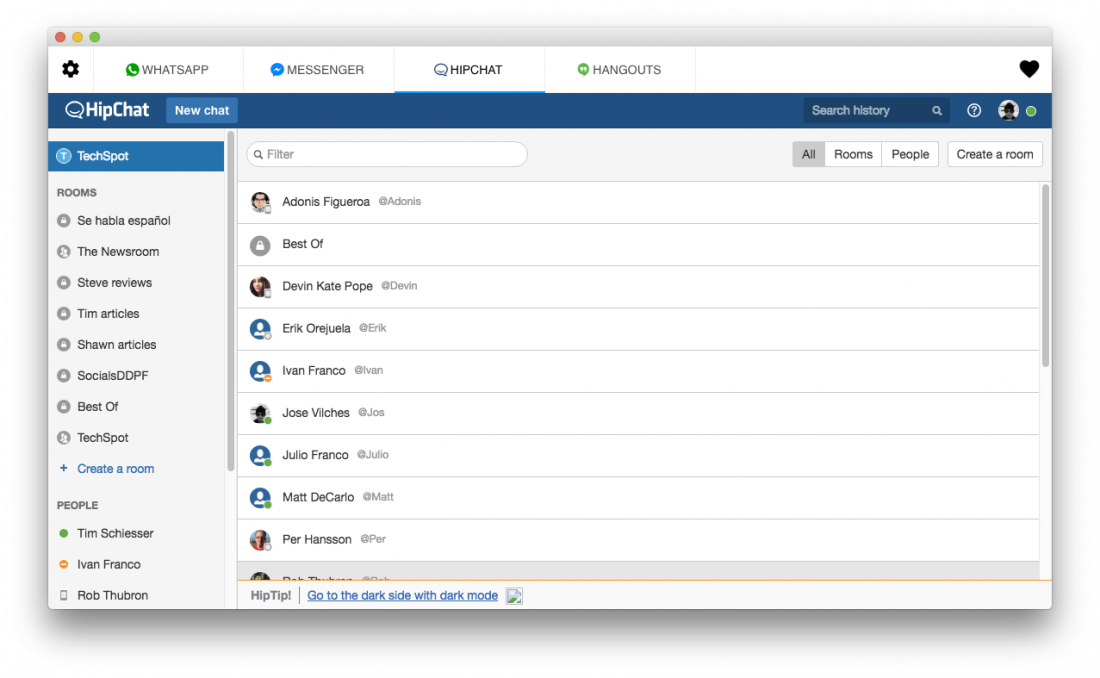
Three Apps to Combine All Your Messaging Clients Into One

Instant messaging is an increasingly competitive market and despite your best efforts to keep it simple and use a single app or platform, it's hard to avoid keeping two or three apps around to keep in touch with different groups of people. In any given day I get hundreds of notifications from HipChat,WhatsAppTelegramSkype, and my business’ Facebook Page.
While most of these clients are mobile-first nowadays, thankfully for my sake all offer some form of desktop counterpart — either a full blown native client or a web based one — so I can reply faster and more comfortably using an actual keyboard. However that doesn’t make switching between different app windows and browser tabs throughout the day any less annoying.
If this sounds familiar, there are a handful of all in one messaging clients that can save you the trouble by keeping all your chats under one roof, and best of all they are cross-platform. The concept isn’t new — remember Trillian, anyone? — but updated for today’s mobile messaging world.

Franz

I’ll tell you right away all three options we’re covering today work similarly as they are essentially wrappers for the web versions of all the supported messaging apps. But Franz is still my favorite of the bunch. It feels polished, fast and is presented in a clean, no-frills interface.
It covers a wide range of services, among them Facebook Messenger, WhatsApp, Slack, Telegram, WeChat, Skype, HipChat, Google Hangouts, GroupMe, Steam Chat, and more. As of writing there are 34 different services in total and development is active so new ones are added regularly. The latest update introduced support for email (Gmail, Inbox by Gmail, and Outlook), Twitter’s TweetDeck client and custom HipChat servers for companies that prefer self-hosted solutions.
Moreover, Franz allows you to add each service many times, which is useful if you manage multiple business and private accounts at the same time. It’s available for Windows, Mac and Linux.

Rambo

Rambox is an open source alternative to Franz that works pretty much the same but covers a lot more services — 74 and counting at the time of publishing this piece — and adds a few bells and whistles of its own. Each service you add is listed in its own tab in the Rambox interface, with notifications handled individually for each service and the option to mute all by enabling Do Not Disturb mode.
Like Franz, you can add each service many times, but a key feature that differentiates Rambox is the ability to add a custom service in case you are using an obscure or niche app that isn’t already listed. As long as the service is accessible via URL, which I tested by adding a tab for Chatra.
Other unique features include the ability to lock the app if you’ll be away for a period of time and setup a password for when you come back or when launching the app. If you use Rambox in different computers, you can synchronize your configuration between them, configure it to use a Proxy if your network blocks some services, and add custom behaviors via custom code injection.
Overall it’s a broader and more flexible alternative, though after using it for a few days it didn’t feel as polished as Franz, and I noticed a little lag while switching between clients. Rambox is also available for Windows, Mac, and Linux and since it’s open source you’re always free to check its inner workings.

All-In-One Messenger

If you’d rather have a solution that lives inside the browser then All-in-One Messenger will be more up your alley. It has a more limited list of supported services but not by much, and all the big ones are there. Like its desktop-based counterparts above, you can use as many accounts of the same messenger platform as you want. You can get desktop notifications with one-click reply and mute specific services if you are being distracted by one of them.
If you are a fan of hotkeys All-in-One supports a few, allowing you to quickly toggle between tabs or jump directly into one of them and reordering within the chat interface.
All-in-One is simple, stable, well designed and uses roughly the same amount of resources they would in a browser tab in Chrome. It’s available as a Chrome Web App, and while I prefer a standalone client, it still serves the purpose for keeping all your messaging clients accessible in a single place. It’s also the only of the three that will work on Chrome OS, so there’s that, too.

Wednesday, September 28, 2016

Apple tracks everyone you contact on iMessage, may share logs with law enforcement

Apple CEO Tim Cook was recently embroiled in a bitter battle with the FBI over anencrypted iPhone. He showed how user privacy is at the helm of the company culture. But, if a new report is to be believed than the iMessage isn’t as secure as you may have thought.
According to The Intercept, Apple may not know what your messages read, but it does know who you are talking to. When a user contacts anyone through Apple messages app, the app pings the server to find out if the recipient has an iMessage account. The report adds that Apple takes a note of the IP address along with the date and time. This could help with providing information on the user’s location.
The information is then stored for 30 days before it is deleted. “This log also includes the date and time when you entered a number, along with your IP address — which could, contrary to a 2013 Apple claim that “we do not store data related to customers’ location,” identify a customer’s location,” the report reads.
“Phone companies routinely hand over metadata about calls to law enforcement in response to pen register warrants. But it’s noteworthy that Apple is able to provide information on iMessage contacts under such warrants given that Apple and others have positioned the messaging platform as a particularly secure alternative to regular texting,” further adds the report.
On contacting Apple, the company told the news site that such details are offered only upon valid subpoena or court order. The statement reads, “In some cases, we are able to provide data from server logs that are generated from customers accessing certain apps on their devices. We work closely with law enforcement to help them understand what we can provide and make clear these query logs don’t contain the contents of conversations or prove that any communication actually took place.”
The Intercept gets the information from a leaked document titled ‘iMessage FAQ for Law Enforcement’, which states its for official purpose only and designated to Florida Law Enforcement Sources. And, it is said that Apple could provide this information to law enforcement when asked by the court.

Friday, September 23, 2016

9 Essential Windows Apps for Students

checked out of the library. However, all is not lost if you find yourself in this situation — an app called OverDrive might be able to help you out.
Windows 10 App OverDrive
Download the app and link it with your library card to gain access to a collection of thousands of eBooks. While some of the texts that you need won’t be available via OverDrive, it’s definitely worth having installed on one of your devices just in case.

7. WolframAlpha to Research Facts and Figures

Whether you’re studying maths, biology, physics, chemistry, history, computer science, engineering, or just about anything else, WolframAlpha has facts and figures that will make your life easier.20 Ways Everyday Life is Easier with Wolfram Alpha 20 Ways Everyday Life is Easier with Wolfram AlphaThere is something about Wolfram Alpha. It makes complicated computations cool again. Here are 20 ways to put the engine to everyday use.READ MORE
In development over the past quarter of a century, WolframAlpha has been compared to the ultra-smart computers used on Star Trek. The app puts a wealth of knowledge in the palm of your hand, answering questions ranging from “what is the capital of Peru?W to “how many meters are in a mile?”
Windows 10 App Wolfram Alpha
WolframAlpha is an app that everyone should have access to — but if you’re a student, you’re sure to find it useful sooner rather than later.

8. Microsoft Office to Create and Edit Documents

Regardless of what courses you’re taking, it’s well worth having Microsoft Office (CAUK) at your disposal. Word will help you produce essays with pristine citations, Excel is great whether you’re studying maths or just in need of an organizational spreadsheet, and PowerPoint should be the first port of call if you need to deliver a presentation to your classmates.
Windows 10 App Office 365 Shared Subscription Costs
The advent of Windows 10 has made it easier than ever to use Office across all your devices. An active Office 365 subscription will let you install the suite of programs on your PC, your phone, and your tablet.How to Save Your Office 2016 Documents to the Cloud How to Save Your Office 2016 Documents to the CloudStore and organize your files in the cloud. Use cloud services like OneDrive,Dropbox, and Google Drive to make your files available anywhere and to anyone.READ MORE
Of course, a subscription that costs $99 per year might not fit into the budget of every student. Fortunately, Google Docs is an excellent, free replacement for anyone that wants to keep their spending to a minimum. There are also several ways to get a free version of Word if you don’t need the entire Office suite.

9. Netflix to Relax

Realistically, Netflix — or at least another comparable streaming service — is an essential app for just about everyone, student or otherwise.10 Niche Streaming Services for Those Who Hate Netflix 10 Niche Streaming Services for Those Who Hate NetflixMainstream streaming services carry mainstream content. What can you do if you want to watch something a little less conventional? You're better off checking out these alternative streaming services packed full of niche content.READ MORE
It’s important to make sure that your binge-watching doesn’t interfere with your studies. However, there’s certainly a place for recreation in a productive academic schedule. It’s OK to take breaks!
Windows 10 App Netflix
Doing something fun and relaxing in your downtime can help maintain your concentration when you’re in class or at the library.
Would you recommend any other essential Windows apps for students? Or are you looking for a piece of software to fit a particular academic purpose? Either way, why not join the discussion in the comments section below.
Related Posts Plugin for WordPress, Blogger...