Saturday, February 18, 2017

ZUK Edge II could be announced with a curved display and dual-camera setup

ZUK Edge II could be announced with a curved display and dual-camera setup

By 
If you remember Lenovo’s sub-brand ZUK announced the ZUK Edge in China back in December. It has just been a couple of months and it seems that a successor to the smartphone is already in place, well atleast a special edition.
A few alleged images of the ZUK Edge II including a special edition dedicated to Luo Tianyi, a Vocaloid character popular in China, have emerged. As you can see the special edition comes in a distinctive blue shade while the regular Edge II could be offered in black. Also, this model actually has a curved display unlike the ZUK Edge which had a flat panel.
zuk-ii-leak (1)
Underneath the display we don’t see any physical button but a faint LED light. At the back there are dual cameras arranged in a vertical layout, again something new for ZUK. There are no specifications or any other details about the handset and considering the ZUK Edge launched just two months back, we are a bit skeptical about this one.
zuk-ii-leak (2)
The ZUK Edge came with the latest Qualcomm Snapdragon 821 quad-core SoC clocked at 2.35GHz. There are two RAM variants 4GB and 6GB with 64GB of storage along with a microSD expansion slot. At the back there is a 13MP rear camera with a 1.34-micron pixel Samsung ISOCELL sensor, an f/2.2 aperture, PDAF+CAF hybrid autofocus, and a high-brightness flash.
There is an 8MP camera on the front with a 1.12-micron pixel sensor, and an f/2.2 aperture. It features a USB Type-C (v3.1) port and a unique under-glass U Touch fingerprint sensor that is said to unlock the phone under 0.09 seconds). It also packs in some unique features like a built-in blood oxygen heart rate sensor, a pneumatic altimeter and a UV light sensor. The smartphone runs on Android 7.0 Nougat with ZUI 2.5 on top. Connectivity options dual-SIM slots, 4G LTE, Wi-Fi, Bluetooth 4.1, GPS/ A-GPS. On the battery front, you get a 3,100mAh unit with Quick Charge 3.0 support.

MWC 2017: The Huawei Honor 8 Pro with dual-camera might make its debut at the event this year

MWC 2017: The Huawei Honor 8 Pro with dual-camera might make its debut at the event this year

A leaked image of the Huawei Honor V9
By 
Rumour has it that Huawei’s Honor 8 Pro will make its debut at the Mobile World Congress 2017 (MWC) event in Barcelona, Spain, this month.
The Honor 8 is available in India and globally. It’s pricing in India places it in direct competition with the OnePlus 3. The Honor 8 Pro is expected to be a premium variant of the existing Honor 8, reports Android Headlines.
The report also adds the that Honor 8 Pro is likely to be the Chinese Honor V9. The V9 was recently spotted on Chinese telecom certification site, TENAA.
The V9, and consequently the Honor 8 Pro, is expected to come with a 5.7-inch QHD display (2560 x 1440), offer 4GB or 6GB of RAM and 64GB or 128GB of storage. The SoC is expected to be a 2.4GHz octa-core unit, but its exact details are unknown. This is likely a variant of the MediaTek Helio architecture. The battery is thought to be a 3,900 mAh unit.
On the camera front we’re expecting to see a 12MP rear camera placed alongside a secondary 12MP camera. The details of the configuration of the cameras is unknown. Huawei’s earlier dual-camera phones, designed in partnership with Leica, placed a colour sensor alongside a dedicated black and white one to enhance image quality.
The front unit is expected to be an 8MP one.
Details of pricing, colours and availability are unknown at this time.

WhatsApp hires Facebook executive Matt Idema as its first COO

WhatsApp hires Facebook executive Matt Idema as its first COO

Image: AFP
By 
WhatsApp has hired Matt Idema, a Facebook executive who was leading product marketing for all the business products made by Facebook worldwide. This hire is suspected to lead WhatsApp into a completely different and contrasting direction than the current scenario. Facebook acquired the company in 2014 for $22 billion. The interesting part of the acquisition is the fact that WhatsApp does not make any money for Facebook. The company also decided to eliminate the subscription fee that WhatsApp charged the users after one year of free usage.
There are hints that the company is thinking about a mechanism to make money out of the massive userbase that WhatsApp commands all over the world. The decision of hire Idema hints towards a push in direction of monetization as reported by Recode. Even though his role has not yet been chalked out inside WhatsApp and it may not be the same as that of product marketing while working with Facebook. But it may very well fit in if rumours are true about WhatsApp working on adding ‘Business profile’ to the platform which will make it easier for businesses to operate and reach consumers beyond emails, calls and SMS.
This surely is a different way from the revenue stream that can be secured from straight up subscription fees, paid app models or advertisements that other companies and developers opt for. But developing a business side of the app and charging money will be a great way which won’t affect normal users. Another important thing to note is the fact that the company won’t really channel all the third-party messages or spam to you but in fact aims at making the addition more useful.
WhatsApp CEO Jan Koum had previously added, “Starting this year, we will test tools that allow you to use WhatsApp to communicate with businesses and organisations that you want to hear from. That could mean communicating with your bank about whether a recent transaction was fraudulent, or with an airline about a delayed flight. We all get these messages elsewhere today — through text messages and phone calls — so we want to test new tools to make this easier to do on WhatsApp, while still giving you an experience without third-party ads and spam.”
One important thing to note is that WhatsApp is heading in almost the same direction as that of Facebook Messenger with hints of impending ‘Bots’ and businesses and brands. The attempts at monetizing platforms are going in the same direction as that of adding Snapchat like features in all its platforms ranging from Instagram to Facebook Messenger and now WhatsApp.

Thursday, February 9, 2017

Surfing internet, excess use of social media networks like Facebook can make you lose track of time

Surfing internet, excess use of social media networks like Facebook can make you lose track of time

Image: Reuters
Facebook addicts, take note! Using the social networking site or surfing the web may impair your perception of time, warn researchers including one of Indian-origin. Using well-established internal clock models, researchers attempted to separate the roles of ‘attention’ and ‘arousal’ as drivers for time distortion. They found that Facebook-related stimuli can lead to an underestimate of time compared to general internet use, but that both lead to a distortion of time.
In the study, Lazaros Gonidis and Dinkar Sharma from the University of Kent in the UK monitored the responses of 44 people who were shown 20 images for varying amounts of time. Five of the images were associated with Facebook, five had more general internet associations with another ten as neutral ‘control’ images. Those taking part had to say whether the image they had just seen had been visible for a short or long time.
The key finding was that people tended to underestimate the time they had been looking at Facebook-related images to a greater extent than other more general internet related images, but that in both cases time was underestimated. This suggests that Facebook-related images affect time by changing how we pay attention to them. The findings are likely to have implications for future study into addictive behaviour. The study was published in the Journal of Applied Social Psychology.
PTI

Apple iCloud stores deleted browsing history almost indefinitely, analyst

Apple iCloud stores deleted browsing history almost indefinitely, analyst

By 
If you’re in Apple’s ecosystem, you’ll need to take a bit more care when deleting your browser history. It turns out that iCloud stores all browsing history, including ‘cleared’ history dating back at least a year, and maybe even longer.
Vladimir Katalov, CEO of Elcomsoft, the maker of various hacking tools, tells Forbes that he discovered this issue when browsing the history on his own phone. Using the Phone Breaker tool developed by his company, he found that iCloud keeps a record of data, even deleted data, going back at least a year.
Apple syncs data between your Apple devices using iCloud, a remote server that syncs data between clients. Servers normally do need a log of deleted data as well to ensure that syncing happens properly, but this data is usually obfuscated to outsiders.
In this case, Katalov and other experts that Forbes consulted appear to believe that Apple simply forgot to make the necessary changes to the platform.
Speaking to a senior ACLU analyst, Forbes has discovered that while the information is available online, it’s almost impossible to access without the username and password of the person whose phone has been compromised. Essentially, law enforcements and criminals will find it almost impossible to access.
If this is indeed something that Apple simply forgot about, the fix should be quite simple.
The best way to avoid getting caught up in this whole hassle is to simply disable iCloud syncing features, particularly on Safari.

Google launches Android Wear 2.0, an evolutionary upgrade to the smartwatch OS

Google launches Android Wear 2.0, an evolutionary upgrade to the smartwatch OS

Image Credit: Google
By 
Google has launched Android Wear 2.0, the newest version that will power smartwatches. The upgrade was announced last year during Google I/O 2016 and the update is a few months late than what was originally planned. The company has not made any revolutionary changes to the smartwatch experience to change how we look at smartwatches. Instead, the company has added updates to many key components of the operating system which will enable faster access to the things that you performed on your Android Wear-powered smartwatch.
Image Credit: Google Android
Android Wear 1.0 was a bit complicated and most of the operations that you wanted to perform seemed more complex than they should be. Google focused on improving this by removing the complexity. The first important change that you will se is the presence of better Watch Faces and an easier way to change Watch Faces.
Image Credit: Google
Google has changed the fundamentals of watch faces by adding space to show information from the system as well as third-party apps like Uber, Nike and other fitness or weather apps. This is done by collecting the information using the Complications API. The process to change Watch Faces is as easy as flicking left or right instead of long pressing on the screen to go to a screen where you can change the watch faces.
Image Credit: Google Android
The second most important improvement is the introduction of standalone apps that don’t need companion apps on your smartphone. You don’t need to install separate apps on your smartphone to help run the Android Wear apps. You can now access Google Play Store on the watch and install new apps without the need of a smartphone. The interface of Android Wear 2.0 is more in line with the Material design guidelines with more emphasis on cards where each notification will get a full screen for its expanded view.
Image Credit: Google
Another significant improvement is the addition of Android Pay to Android Wear 2.0. You can use your Android Wear 2.0 powered Smart watch to pay using Android Pay. One thing to note is that the smart watch should be equipped with NFC  and your smartphone must have a locked bootloader.
Image Credit: Google
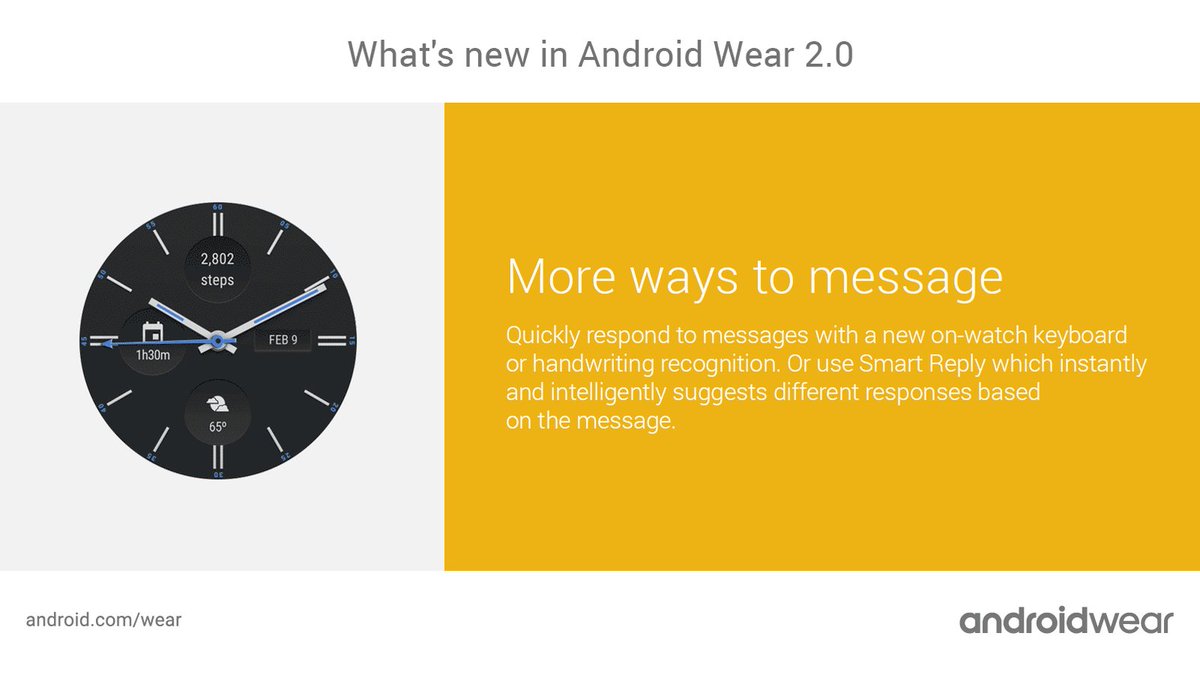
Google has improved other things like the Google Fit app for Google Android Wear where it now supports more type of workouts and exercises. One interesting thing to note is that Android Wear 2.0 comes with a keyboard to type your responses on. One would obviously not use that keyboard to write long articles or something huge in size. The major thing that makes the keyboard on Android Wear 2.0 significant is that you no longer need to swipe across a Qwerty layout screen to type a message. Instead, the keyboard is powered using the powerful prediction engine of Google Keyboard which works surprisingly well. You can also handwrite messages or use smart reply for Google Assistant.
Last but not the least, Google has added Google Assistant to Android Wear 2.0 making it a significant improvement over Android Wear 1.0 and Google Now. This is almost like Google Assistant on Google Home or Google Pixel smartphone. One thing to note is that Google has changed its philosophy after realising that one does need some physical input to operate Android Wear, making the presence of buttons and dials mandatory on the new models of watches; a far cry from what it was earlier.

The world’s first Google Station Wi-Fi hotspot will be set up in Pune

The world’s first Google Station Wi-Fi hotspot will be set up in Pune

Image: Google
By 
It’s official, India will be the first country in the world where Google will deploy Google Station. It’s a fast Wi-Fi initiative that aims to bring high-speed internet access to public areas.
While India is the lucky country to get the station, the lucky city where the service will first be deployed in Pune. Google Station is a collaborative project between IBM, Larsen and Toubro and RailTel.
It’s a Rs 150 crore project that’s won by these companies as part of Pune’s Smart City initiative, reports The Economic Times.
Unlike Google’s earlier Railwire project with RailTel, the purpose of Google Station is to provide fast access to the internet in public areas and then eventually monetise the whole system. The smart city council will take a share of this revenue.
As with Railwire, Google will primarily provide the platform support required to integrate Wi-Fi access across a multitude of locations with a single sign-on process. Users will simply need to authenticate via OTP.
L&T is reportedly the ‘master system integrator’ for the project and will provide much of the infrastructure required.
Public call boxes, PA systems, environmental sensors and more will be integrated into the system.
ET reports that Google is working with the Pune government for the deployment of variable messaging displays as well.
IBM’s solutions will provide the “backbone” for Pune’s Smart City Network, the report adds.

Related Posts Plugin for WordPress, Blogger...