Showing posts with label Sundar Pichai. Show all posts

Wednesday, April 12, 2017

Google’s new machine learning model can harness the processing power of your phone to improve AI

Google’s new machine learning model can harness the processing power of your phone to improve AI

Image: Google
Google’s new machine learning algorithm harnesses the processing power of your smartphone to improve algorithms and save on data consumption by intelligent virtual assistants and the like.
Using a process called Federated Learning (FL), Google claims that they can “collaboratively share a prediction model while keeping training data on the device.” It might sound complicated, but it’s actually a simple, well thought-out solution to a problem that’s been haunting machine learning for years.
Machine Learning (ML) is used to design algorithms. These algorithms help in the functioning of what we know as artificial intelligence (AI). Siri, Google Assistant, Bixby, they’re all just algorithms.
But ML is used for more than just digital assistants. Google’s self-driving car, for example, learns to drive using ML. Essentially, data is harvested and analysed and then an algorithm is developed based on the results. This one-line description grossly oversimplifies how ML works, but you get the general idea.
For example, if you normally drink your coffee at 6 AM every day on weekdays and at 8 AM on weekends, ML will analyse the data and determine your coffee drinking patterns, potentially automating your coffee making process if you have, say, a smart coffee maker. More data might lead the algorithm to determine that you drink coffee late on public holidays as well, or the data might be tied to your heart rate, etc.
The possibilities are endless, but are predicated on a large amount of data, some of it very revealing and potentially a privacy nightmare.
Image: Google
Image: Google
Traditionally, this data would need to be harvested by some device, like your smartphone, and then sent to the cloud for processing. ML is then used to analyse the data further and learn from it, further improving algorithms.
As Google explains in its blog-post, this approach requires low-latency, high-bandwidth data transfer rates. Of course, the privacy issues also raise their head here and taking responsibility for the data can put a company in a tricky spot.
With FL, Google has changed how the learning process works. As they describe it, “your device downloads the current model, improves it by learning from data on your phone, and then summarises the changes as a small focused update.”
The data that’s actually sent to the cloud is the updated algorithm and not the actual data itself. The data remains on your phone at all times.
Google’s cloud-based FL then aggregates these updates and creates an improved model for all devices. This updated model is then sent to devices as an update and the process repeats itself.
Using this technique, Google claims that bandwidth needs can be dropped by up to 100x.
Better yet, for the sake of privacy, the cloud-based processing won’t happen unless “100s or 1000s of users have participated.” This ensures that the updates from a single user cannot be identified.
The updated algorithms that your phone creates are sent to the cloud in a compressed and encrypted manner to begin with.
Google has deployed this technique in their Gboard app to help improve its natural language processing, but as they refine the process, they hope to expand FL’s scope to other applications as well.
FL has the potential to fundamentally change the way models are developed in the future. More information can be found here.
Publish date: April 12, 2017 11:16 am| Modified date: April 12, 2017 11:16 am

Tuesday, January 31, 2017

Trump executive order: Google employees’ protest, sends across a strong point

Trump executive order: Google employees’ protest, sends across a strong point

Image: Reuters
By 
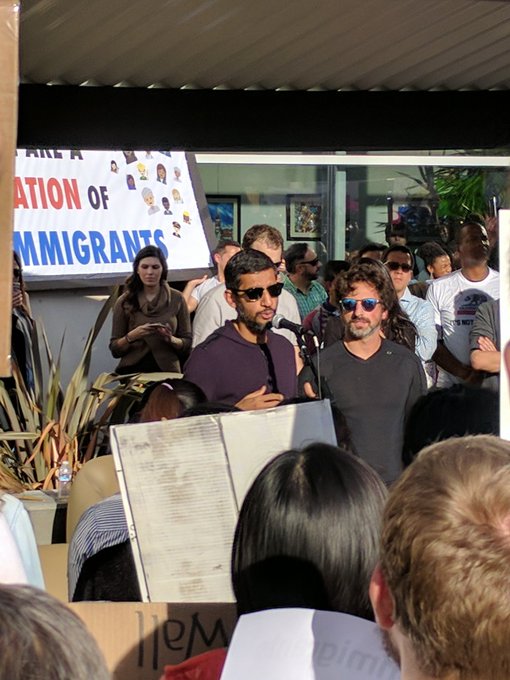
Google is one of the most influential internet companies in the world and part of a tech conglomerate Alphabet. It is also a company whose employees have been quite vocal in their criticism of the executive order that was passed by Trump targetting immigrants. Sure, a lot of tech CEOs raised their voices against the order. We have a whole list here. But in the case of Google, it is not only the CEO, but also a co-founder, former CEO as well as the Google employees themselves, who have made their stand clear over the last few days.
Walking the talk
Pichai in an email to staff said the US ban on foreign nationals from seven Muslim-majority countries will hit at least 187 Google employees.
“We are upset about the impact of this order and any proposals that could impose restrictions on Googlers and their families, or that could create barriers to bringing great talent to the US,” the Wall Street Journal quoted Pichai as saying in the email. “It is painful to see the personal cost of this executive order on our colleagues,” he said.
Google co-founder Sergey Brin, whose family immigrated to the US in 1979 from the then Soviet Union, took part in the protests taking place at the San Francisco international airport. While protesting in his personal capacity, Brin said that he was protesting because he himself was a refugee.
Recently at a meeting with Google employees, Eric Schmidt, the executive chairman of Alphabet said “that the Trump administration is going to do evil things as they’ve done in the immigration area and perhaps some others.” Schmidt did say that the government is focussed on economic growth in his meeting with employees. He said that these ‘evil things’ will be done while keeping the focus on the growth rate in the US by increasing federal spending.
According to reports, there were about 2000 employees participating in the protest on 30 January, and these included Google top brass like Sundar Pichai and Sergey Brin, both of whom are technically immigrants.
Google has also set up a $4 million fund for immigrants. This fund includes $2 million contributed by Google’s own employees. All things point to the fact that Google employees, while not in the official capacity, are taking a political stand by their actions and gestures.
Wooing the Republicans
It is no secret that Google backed Democrat candidate Hillary Clinton during the Presidential elections. But the company has since been trying its best to get into the good books of the Trump administration as well. According to Bloomberg Google had sought a ‘DC veteran to act as liaison to conservative, libertarian and free market groups’.
Image: Reuters
Image: Reuters
However, Google / Alphabet have made it public whenever it has met with Trump. For instance, when Trump met with the top tech CEOs from Silicon Valley, Larry Page was present. More recently, even Eric Schmidt had met the president at the Trump Tower. According to Buzzfeed, Google states that it was better to work behind the scenes with the administration, rather than making statements which would antagonise people from the administration with whom Google / Alphabet has to work.
Schmidt has also stated to his employees that he did all he could in his power to dissuade the administration from taking an anti-globalisation and discriminatory stand on the immigration order, but nothing has come out of it.
AP
Image: AP
Pichai has also tried to explain why it is counterproductive for Google as a company to take a stand officially. In a statement to Vice News, Pichai said, “If you publicly take a strong position, once they’ve identified you’re completely on one side, you lose the ability to come to a rational position. We get very strong reactions when we try to reach out to the other side. Taking public positions is productive in some cases, and counterproductive in others.” According to a New York Times report, Google also recently organised an event for Republican lawmakers.
Treading a fine line
While on the one hand Google and Alphabet employees are protesting against the controversial executive order, on the other hand, it is trying to be in the good books of the Trump administration as well. In doing so, Google and its parent company Alphabet are trying to find a right balance between its employees putting forth a resistance against unfair orders, at the same time not antagonising the government in the official capacity.
At the end of the day, a lot of Google and Alphabet’s projects require government co-operation. So it is treading a path which any profit-making institute would take.
Targetting immigrants from certain nations based on religious lines, specially when a lot of the top US companies have been built by immigrants, smacks of arrogance. It is then heartening to see employees of the Silicon Valley tech giants taking to the streets to protest against this unfair executive order.
Whether the companies or its employees would be punished for these protests, is something only time will tell. But if there are penalties to be paid, then that would set a wrong precedent.

Sunday, January 29, 2017

Silicon Valley isn’t happy: Here’s what top tech CEOs have to say about US President Trump’s immigration order

Silicon Valley isn’t happy: Here’s what top tech CEOs have to say about US President Trump’s immigration order

Image: Reuters
By 
US President Donald Trump has passed an executive order which halts immigration from seven Islamic nations including Iraq, Iran, Libya, Somalia, Sudan, Yemen, and Syria, for at least 90 days. For Syrian refugees, the ban is indefinite. Trump said that the order was to keep away radical Islamic terrorists.
This has caused a lot of furore not just among the general population, but also among technology companies.
Most of the top technology firms in the US are filled with staff who aren’t native US citizens. And logically enough, most leaders from across the technology industry spectrum have criticised this new temporary ban that Trump has issued.
Microsoft Corp, Alphabet Inc, Apple Inc, Facebook Inc and Uber Technologies and many other companies have expressed concern about the immigration order’s effects on their employees, according to the Wall Street Journal. 
Here is what the heads of top US tech companies have to say about this order.
Microsoft CEO Satya Nadella, himself an immigrant told the Wall Street Journal that he had experienced and seen the positive impact that immigration has had on Microsoft as well as for the US and the world. He said that Microsoft Corp would continue being an advocate on the issue.
Apple CEO Tim Cook has sent an email to his employees assuring them that Apple has contacted the White House to explain the negative effects of such restrictions. Cook had also spoken about the importance of immigration, both to Apple and the US’s future, when he had visited Washington last week.
Google CEO Sundar Pichai said that the order affected close to 187 current Googlers. “We’re upset about the impact of this order and any proposals that could impose restrictions on Googlers and their families, or that could create barriers to bringing great talent to the US. It is painful to see the personal cost of this executive order on our colleagues,” he said.
Facebook CEO and founder Mark Zuckerberg put out a status on his Facebook pagestating that both his and his wife’s parents were immigrants to the US. “We need to keep this country safe, but we should do that by focusing on people who actually pose a threat. Expanding the focus of law enforcement beyond people who are real threats would make all Americans less safe by diverting resources, while millions of undocumented folks who don’t pose a threat will live in fear of deportation,” said Zuckerberg.
Digital storage firm Box’s CEO Aaron Levie said that the move was quite infuriating and morally wrong. He said that he was looking at ways to get personally involved and fight the order.
Amazon’s vice president for HR, Beth Galetti, said that a diverse workforce helps Amazon make better products for its customers. It has sent out an email to its staffers, recommending US based employees from countries in the ban-list, from travelling outside the US. It has also asked such employees to get in touch with the company if they are already outside the borders for travel or work.
Netflix CEO, Reed Hastings, in a personal post on his Facebook page said, “Trump’s actions are hurting Netflix employees around the world, and are so un-American it pains us all. Worse, these actions will make America less safe (through hatred and loss of allies) rather than more safe. A very sad week, and more to come with the lives of over 600,000 Dreamers here in a America under imminent threat. It is time to link arms together to protect American values of freedom and opportunity.”
Uber CEO Travis Kalanick has sent out an email to his employees titled, ‘Standing up for what’s right.’ Kalanick goes on to talk about the executive order issued by Trump and how it affects Uber drivers. He said that Uber will be reaching out to all its drivers who work in the US but go home for long breaks to be with family. These drivers affected by the order will be compensated for three months, pro bono, said Kalanick.
“While every government has their own immigration controls, allowing people from all around the world to come here and make America their home has largely been the U.S.’s policy since its founding. That means this ban will impact many innocent people—an issue that I will raise this coming Friday when I go to Washington for President Trump’s first business advisory group meeting,” he said.

Wednesday, November 16, 2016

Google announces major investment in London assuring commitment to post-Brexit UK

Google announces major investment in London assuring commitment to post-Brexit UK

Image Credits: Reuters
Google delivered a vote of confidence in London’s future as a technological hub after the Brexit vote on Tuesday by announcing plans for a new building in the King’s Cross area of the city that will house thousands of extra engineers. Google’s Chief Executive Sundar Pichai said computer science had a great future in Britain, citing the talent pool, educational institutions, and passion for innovation present in the country.
“That’s why we are investing in London in both engineering talent and infrastructure,” he said. The 10-storey building, Google’s first wholly owned and designed outside the United States, will increase its presence in King’s Cross to more than 1 million square feet, enough for more than 7,000 employees in total, the company said.
Google has 5,700 employees and contractors in the UK, including about 2,000 engineers housed in the recently opened building in King’s Cross where Pichai announced the expansion. Pichai, who became CEO in October 2015 when parent company Alphabet Inc was created, said he was optimistic about Britain’s future, despite the uncertainty caused by June’s vote to leave the European Union.
“Historically, the UK has been an open and connected economy, and like a lot of businesses we are proud of and rely on the fact that we recruit the best talent from around world,” he said. “We are optimistic that this situation will continue.” “We understand there is uncertainty and even concerns about topics like Brexit and the pace of technological change in our times, but we know for certain that web and digital technology will be an engine of growth for the UK for years to come.”
British Finance Minister Philip Hammond said the investment showed leading firms were still choosing to invest in Britain, while the Mayor of London Sadiq Khan said inflows remain “robust” post-Brexit. “London isn’t just the tech capital of Europe, we are on the shoulder of New York and we are catching up with Silicon Valley,” Khan said at the event.
“Investment into the capital post-Brexit remains robust, so Google’s expansion will further strengthen our city’s reputation as a global leader in digital technology.” Pichai made reference in his speech to another event that exposed a division in a western society: the U.S. election. “Recent events, including the election in the U.S., have clearly surfaced challenges with inequality and people feeling marginalized,” he said.
These were “long-term and difficult” problems to solve, he said, but it was his hope that Google would play a constructive role in addressing some of these challenges. The company, along with Facebook, on Monday announced measures aimed at halting the spread of “fake news” on the internet by targeting how some purveyors of phony content make money: advertising. The shifts comes as Google, Facebook and Twitter Inc face a backlash over the role they played in the U.S. presidential election by allowing the spread of false and often malicious information that might have swayed voters toward Republican candidate Donald Trump, who won the Nov. 8 vote.
Reuters

Monday, October 31, 2016

Google Pixel: Company wants to make voice-powered Assistant better than rivals Siri and Cortana

Google Pixel: Company wants to make voice-powered Assistant better than rivals Siri and Cortana

About six months ago, people working on hardware and the voice-activated Google Assistant for the Pixel phone started sitting next to each other at the company’s Mountain View, California headquarters, hammering out minute details of its first phone.
The new seating arrangement illustrated a much larger shift underway at Alphabet Inc’s Google, which crashed Apple Inc’s smartphone revolution eight years ago by giving away its Android software and letting handset makers do the rest.
Google software now runs on 85 percent of the world’s smartphones, but as voice control threatens to replace touch as the primary means of using a hand-held device, the company is experimenting with a different approach – more akin to Apple’s tight integration of hardware and software.
The Pixel’s hardware and Assistant teams gather for happy hour every Friday and have already received a prototype for the camera on next year’s phone, said Brian Rakowski, vice president of product for Google’s Android operating system.
Their ambition: to make the company’s voice-powered digital assistant better than rivals such as Apple’s Siri and Microsoft Corp’s Cortana.
“We really wanted the Assistant on the phone to feel like a natural extension of the ways you ask Google for information,” Rakowski said in an interview.
LEAF FROM APPLE’S BOOK
The fusion of hardware and software is key to that goal. Certain specifications are crucial for a high-performing assistant, such as a well-placed microphone and a powerful processor to crunch reams of data.
Creating an app isn’t enough; that requires a few clicks for users to get to it.
The hardware and software teams worked closely on details such as the graphics that appear when users call up the assistant, settling on a flurry of colorful dots, which Rakowski called a “whimsical touch to give a little bit of life to the home button.”
The Assistant is always at the ready on the Pixel phone and can be summoned by pressing the home button or saying the words “OK Google.”
By integrating the Assistant into the Pixel, Google “doesn’t have to do negotiations with another handset maker – they can make it as tight as they want,” said Charles Jolley, chief executive of Ozlo, which offers a digital assistant by the same name.
To make sure users get the best possible experience, the Assistant will live only on Google products such as the Pixel, at least for now.
In the long term, however, it is unclear whether Google will keep it that way, or return to its original phone strategy and try to push the product out to the millions of smartphones running on other manufacturers’ Android phones, at the risk of offering a slightly lower-quality experience.
Rakowski said making sure the Assistant works well on other phones would require a close level of integration with handset makers, beyond the typical work that happens on the Android operating system.
“We want all these features of the Assistant to work well and work quickly and be nicely integrated so it gives the right idea of what the Assistant can do,” he said “We don’t want it to feel limited or bolted on in any way.”
He admits it could be challenging to execute the Assistant on some current Android phones.
“You can’t do some of the always-on ‘OK Google’ detection on some phones because they don’t include the right hardware to do that,” he

Thursday, October 6, 2016

Google, Disney, Apple won't bid for Twitter; stock plummets almost 10 percent


By Rob Thubron on October 6, 2016, 7:30 AM


The last few weeks have been awash with claims that several large companies are showing an interest in buying ailing social network/news site Twitter. The prospect of an acquisition sent the company’s share price soaring, but it seems this may have been slightly premature: all of the former suitors are no longer planning to make a bid for Twitter.

Last month, Disney became the latest company to be linked with a possible Twitter takeover, but Recode reports that although the organization had considered a bid, it won’t be making an offer, according to sources familiar with the matter.

Google has been showing an interest in acquiring Twitter for over a year. Many expected Sundar Pichai’s company to make a move; after the failure of Google+, it wouldn’t be a surprise to see Google try to break into social media with an established, if struggling, platform. However, sources close to the situation say Google won’t be moving forward with a bid.

Apple was also thought to be considering an offer, but sources say that Twitter should have “low expectations” of hearing from the iPhone maker. With those three companies all but ruling themselves out, it appeared that cloud computing giant Salesforce was favorite to step in. But Business Insider reports that CEO Marc Benioff doesn’t seem that enthusiastic.

"I think it’s a great brand and I just wish Jack [Dorsey] very well...good on his company, that’s how I look at it today," Benioff said. "We look at everything, and we don’t buy most things, and we haven’t agreed to buy that company [...] it’s an unpolished jewel."

A Bloomberg report claims that the situation is made worse by an internal battle between CEO Jack Dorsey, who wants to keep Twitter independent, and co-founder and board member Ev Williams, who believes selling the firm is the best option. The in-fighting has reportedly led to Chief Financial Officer Anthony Noto seizing de facto control of the company.

All this is bad news for Twitter. Its stock fell more than 9 percent to $22.58 in after-hours trading on the news that it’s struggling to find a buyer.

OurMine hacks Buzzfeed in retaliation for publishing details of alleged member


By Rob Thubron on October 6, 2016, 12:30 PM


You may be familiar with the name OurMine. The group has been responsible for several high-profile hacks of celebrities and some of the most famous CEOs in the tech industry, including Facebook’s Mark Zuckerberg, Google’s Sundar Pichai, and Uber’s Travis Kalanick. Now, the hackers have hit BuzzFeed in retaliation for an article that exposed one of its alleged members.

Joseph Bernstein’s investigation identified Saudi teenager Ahmed Makki as a member of OurMine. The group denied this, claiming he was “just a fan,” but the story appears to have touched a nerve – BuzFeed was hacked the morning after the report, with the titles of several articles changed to “Hacked by OurMine.”

The body of several stories, including Bernstein’s, had the following text added: “Don’t share fake news about us again, we have your database. Next time it will be public. Don’t f**k with OurMine again.”

It’s unclear precisely what database the group is referring to, or what information it contains, though an email to The Guardian from an account associated with the hackers claims it was “Emails, Password Hashes, Usernames.”

There has been no comment from Makki, but OurMine’s website states: “Yesterday Buzzfeed Created a post that we are only 1 member called Ahmed Makki, and we can confirm that we don’t Have a member called ‘Ahmed Makki’ and we are now 4 we were 3 but someone joined, and we hacked it because they are reporting fake news about us.”

“We have a member known as ‘Makki’ But not ahmad makki, and he is not from Saudi Arabia.”

BuzzFeed quickly restored the affected articles, including the original OurMine exposé, back to their original state.

OurMine said the only reason it infiltrates accounts is to show that nobody is secure, using the exposure to advertise its services so people can stay “safe from other hackers.”
Related Posts Plugin for WordPress, Blogger...