Showing posts with label LinkedIn. Show all posts

Monday, January 9, 2017

Russian authorities ask Apple and Google to remove LinkedIn from their app stores

Russian authorities ask Apple and Google to remove LinkedIn from their app stores

Image: Reuters
Accusing LinkedIn of flouting local laws that require internet firms to store data on citizens within the nations borders, the Russian authorities have asked Apple and Google to remove the professional networking site app from their online stores.
Recently, a Russian court blocked the Microsoft-owned LinkedIn service for breaching the country’s data protection rules. According to The New York Times, Apple has confirmed that it was asked to remove its LinkedIn app in Russia about a month ago.
“However, Google has not confirmed if it had removed LinkedIn in Russia but said that it adhered to Russian local laws,” the report added. Meanwhile, LinkedIn responded that the company was “disappointed” with the decision by Russian regulators to block the service.
“It denies access to our members in Russia and the companies that use LinkedIn to grow their businesses,” Nicole Leverich, a spokeswoman for LinkedIn, was quoted as saying. LinkedIn has several million users in Russia.
Earlier this week, Apple removed the New York Times from its app store following a request from Chinese authorities claiming the app was in violation of regulations.
China is known for banning digital sites like Facebook and Google that it believes harm its national security or promote misinformation. The Wall Street Journal’s Chinese-language site has been blocked since 2014.
IANS

Thursday, December 8, 2016

European Commission gives its approval for Microsoft acquisition of LinkedIn

#MICROSOFT

European Commission gives its approval for Microsoft acquisition of LinkedIn
The European Commission has approved the Microsoft acquisition of LinkedIn, subject to conditions. The approval follows an investigation by the European Commission into how Microsoft could use its strong market position to expand the userbase on LinkedIn. The commission was concerned about the effect on competing professional social networking supports if Microsoft were to pre-install LinkedIn on Windows PCs and combine the LinkedIn user database with that of Microsoft.
Customer Relationship Software services was another area of concern. The European Commission evaluated if Microsoft could shut out competition by bundling Microsoft Customer Relationship Management Software with Sales Intelligence Solutions from LinkedIn, and denying competing Customer Relationship Management solution vendors from access to the full LinkedIn database.
The investigation found out that the LinkedIn Sales Intelligence product is not a must have solution, and that access to the LinkedIn database is not necessary for competing in the Customer Relationship Software services market. Additionally, the European Commission has found that Microsoft is a relatively minor player in the market, with the market dominated by SAP, Oracle, and the clear leader, Salesforce.
The commission has approved the acquisition with a few conditions. The conditions are that Microsoft should not install LinkedIn by default on its operating system, and allow users to uninstall the service if it does choose to bundle it with the OS by default.
Competing professional social network service providers should be allowed to maintain current levels of integration with Microsoft products. The European Commission wants Microsoft to provide access to “Microsoft Graph” to competing Professional Social Networking service providers. Developers can use data available through this gateway to drive user adoption.

Thursday, November 10, 2016

Russian court upholds decision to ban LinkedIn over data policy

Russian court upholds decision to ban LinkedIn over data policy

Representational image
A Russian court on Thursday upheld a decision to block the website of social networking company LinkedIn Corp., Interfax news agency reported, setting a precedent for the way foreign internet firms operate in the country.
Russia’s Roskomnadzor communications watchdog has said LinkedIn, which has more than 6 million registered users in Russia, was violating a law requiring websites which store the personal data of Russian citizens to do so on Russian servers.
Moscow has said the law, introduced in 2014 but never previously enforced, is aimed at protecting Russians’ personal data. Critics see it as an attack on social networks in a country which has increasingly tightened control over the Internet in recent years.
Moscow’s Tagansky District Court ruled in August that LinkedIn’s site should be blocked, but the decision had not yet come into force pending a company appeal. “The decision of the Tagansky District Court has been upheld, the appeal by LinkedIn Corporation is unsatisfactory,” Interfax quoted a court decision as saying. Russia will take action to block LinkedIn’s website within the next week, RIA news agency cited a Roskomnadzor spokesman as saying.
“LinkedIn’s vision is to create economic opportunity for the entire global workforce. The Russian court’s decision has the potential to deny access to LinkedIn for the millions of members we have in Russia and the companies that use LinkedIn to grow their businesses,” a LinkedIn’s spokesman told Reuters. “We remain interested in a meeting with Roskomnadzor to discuss their data localization request.”
Roskomnadzor did not immediately reply to a request for comment. While some companies such as online reservations site Booking.com have said they will transfer the necessary data to Russian servers, it is unclear whether others, including Facebook and Alphabet unit Google, will comply with the law.
Reuters

Friday, September 30, 2016

Security analyst says Yahoo!, Dropbox, LinkedIn, Tumblr all popped by same gang Says five-strong 'Group E' may have lifted a billion Yahoo!records, sells to states


30 Sep 2016 at 06:17, Darren Pauli


Five hackers are said to be behind breaches totalling up to a staggering three billion credentials from some of the world's biggest tech companies including the Yahoo! breach that led to the loss of 500 million credentials.

The claims, made to The Reg by recognised threat intelligence boffin Andrew Komarov, pin the world's largest hacks on "Group E", a small Eastern European hacking outfit that makes cash breaching companies and selling to buyers including nation states.

Komarov told The Register the group is behind a laundry list of hacks against massive household tech companies including the breach of Yahoo!, Dropbox, LinkedIn, Tumblr, and VK.com among other public breaches.

The analyst says the same hacking group has breached other major tech firms but would not be drawn on revealing the names of the affected companies nor the number of compromised credentials. Komarov has reported those breaches which are not on the public record to police.

He goes further and says much of the reporting concerning the Yahoo! breach was inaccurate, and suggests the number of affected credentials could be as high as one billion, double what was reported.

Group E had, according to Komarov, breached Yahoo! and sold the massive data haul through a recognised hacker identity who served as a broker.

It was then sold to a unnamed nation-state actor group.

Komarov's employer InfoArmor says it performed "extensive analysis of collected intelligence" from the Yahoo! hack from different sources to "clarify the motivation and attribution of the key threat actors" concluding "many recent press reports and published articles have significant inaccuracies".

Yahoo! last week pinned the breach on a unnamed state actor but did not say if, as Komarov claims, that the group bought the credentials from Group E which conducted the intrusion.

The company did not respond to a request for comment by the time of publication.
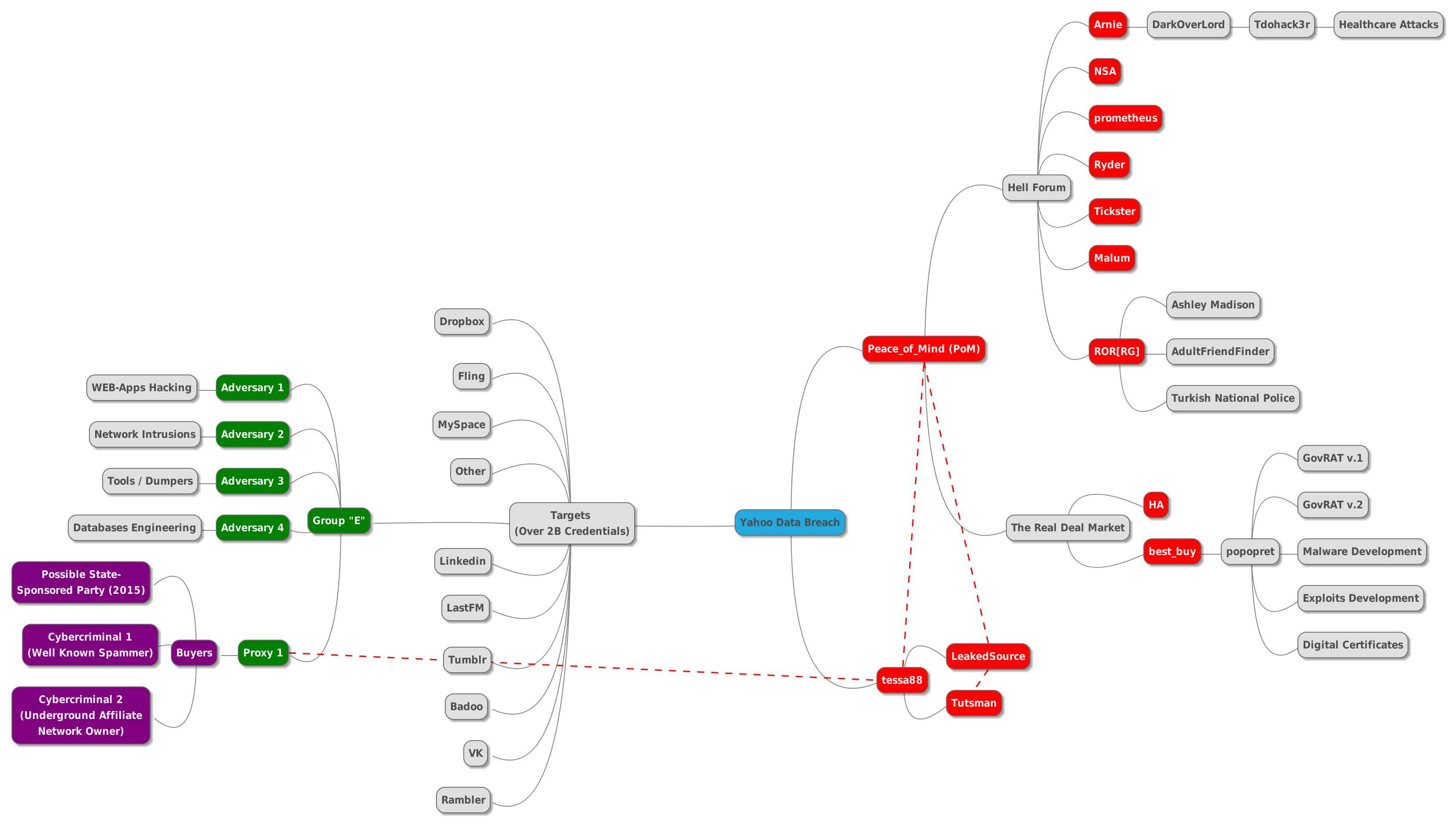

Hacking gangs Group E, For Hell, and broker Tessa88. Mind map by Andrew Komarov.

Komarov tells The Register Group E, so called after the first letter of its leader's moniker, broke into sites using a variety of attack vectors.

"Web apps vulnerabilities and exploitation, plus network intrusion through infection … [and] direct access to databases and source code," Komarov says.

Sites breached by the five-person Group E hacker outfit. Statistics via Andrew Komarov
Breach companyNumber of recordsYahoo! 500 million (up to 1bn)
Myspace 360 million
LinkedIn 167 million
Vk.com 137 million
Qip.ru 133 million
Badoo 126 million
Dropbox 103 million
Rambler.ru 101 million
Tumblr 50 million
LastFM 43 million
Fling.com 40 million
Mobango.com 6 million
Other combined dumps: 600 million


A second group known as "For Hell" used the same broker to sell stolen databases and masterminded other high profile breaches. Komarov says one member known as ROR[RG}) hacked Ashley Madison, Adult Friend Finder, and the Turkish National Police, while a second team mate known as "arnie" or "darkoverlord" conducted breaches of unnamed health care organisations.

Komarov, an established threat intelligence man formerly of Intelcrawler before its acquisition by Arizona-based security firm InfoArmor, is one of a handful of cybercrime intelligence analysts who closely monitor closed crime forums and dark web sites.

He fingers a Russian-speaking criminal hacking identity known as Tessa88 as the broker used by the two hacking groups.

That broker is claimed by hackers including some speaking to Vulture South to be a part-time scammer for selling bogus credentials, although the claims cannot be verified. Komarov says Tessa88 was at pains to mask the identity of the hacking groups when selling the Yahoo! credentials to the nation-state actors.
Related Posts Plugin for WordPress, Blogger...