Showing posts with label hacking. Show all posts

Tuesday, May 2, 2017

Insecure Apps that Open Ports Leave Millions of Smartphones at Risk of Hacking


The University of Michigan team says that the actual issue lies within apps that create open ports — a known problem with computers — on smartphones.

So, this issue has nothing to do with your device's operating system or the handset; instead, the origin of this so-called backdoor is due to insecure coding practices by various app developers.


The team used its custom tool to scan over 100,000 Android applications and found 410 potentially vulnerable applications — many of which have been downloaded between 10 and 50 Million times and at least one app comes pre-installed on Android smartphones.

Here I need you to stop and first let's understand exactly what ports do and what are the related threats.

Ports can be either physical or electronic in nature. Physical ports are connection points on your smartphones and computers, such as a USB port used to transfer data between devices.

Electronic ports are those invisible doors that an application or a service use to communicate with other devices or services. For example, File Transfer Protocol (FTP) service by default opens port 21 to transfer files, and you need port 80 opened in order to connect to the Internet.

In other words, every application installed on a device opens an unused port (1-to-65535), can be referred as a virtual door, to communicate for the exchange of data between devices, be it a smartphone, server, personal computer, or an Internet-connected smart appliance.

Over the years, more and more applications in the market function over the Internet or network, but at the same time, these applications and ports opened by them can be a weak link in your system, which could allow a hacker to breach or take control of your device without your knowledge.

This is exactly what the University of Michigan team has detailed in its research paper [PDF] titled, "Open Doors for Bob and Mallory: Open Port Usage in Android Apps and Security Implications."

According to the researchers, the major issue is with the apps like WiFi File Transfer, which has been installed between 10 million and 50 million times and allows users to connect to a port on their smartphone via Wi-Fi, making it easy to transfer files from a phone to a computer.

But due to insufficient security, this ability of the apps is apparently not limited to merely the smartphone's owner, but also malicious actors.

However, applications like WiFi File Transfer pose fewer threats, as they are designed to work over a local network only, that requires attackers to be connected to the same network as yours.

On the other hand, this issue is extremely dangerous in the scenarios where you connect to a public Wi-Fi network or corporate network more often.

To get an initial estimate on the impact of these vulnerabilities, the team performed a port scanning in its campus network, and within 2 minutes it found a number of mobile devices potentially using these vulnerable apps.
"They manually confirmed the vulnerabilities for 57 applications, including popular mobile apps with 10 to 50 million downloads from official app marketplaces, and also an app that is pre-installed on a series of devices from one manufacturer," the researchers say.

"The vulnerabilities in these apps are generally inherited from the various usage of the open port, which exposes the unprotected sensitive functionalities of the apps to anyone from anywhere that can reach the open port."
No doubt, an open port is an attack surface, but it should be noted that port opened by an application can not be exploited until a vulnerability exists in the application, like improper authentication, remote code execution or buffer overflow flaws.

Besides this, an attacker must have the IP address of the vulnerable device, exposed over the Internet. But getting a list of vulnerable devices is not a big deal today, where anyone can buy a cheap cloud service to scan the whole Internet within few hours.

However, smartphones connected to the Internet via wireless network behind a router are less impacted by this issue, because in that case, attackers would need to be on the same wireless network as the victim.

To prove its point, the team of researchers has also demonstrated various attacks in a series of videos, posted below:

1. Using an app's open ports to steal photos with on-device malware

2. Stealing photos via a network attack

3. Forcing the device to send an SMS to a premium service

The team says these vulnerabilities can be exploited to cause highly-severe damage to users like remotely stealing contacts, photos, and even security credentials, and also performing sensitive actions such as malware installation and malicious code execution.

The easiest solution to this issue is to uninstall such apps that open insecure ports, or putting these applications behind a proper firewall could also solve most of the issues.

Saturday, February 18, 2017

FBI starts three probes in suspected Russian hacking of U.S presidential elections

FBI starts three probes in suspected Russian hacking of U.S presidential elections

Image Credit: Venture Beat
The U.S. Federal Bureau of Investigation is pursuing at least three separate probes relating to alleged Russian hacking of the U.S. presidential elections, according to five current and former government officials with direct knowledge of the situation. While the fact that the FBI is investigating had been reported previously by the New York Times and other media, these officials shed new light on both the precise number of inquires and their focus.
The FBI’s Pittsburgh field office, which runs many cyber security investigations, is trying to identify the people behind breaches of the Democratic National Committee’s computer systems, the officials said. Those breaches, in 2015 and the first half of 2016, exposed the internal communications of party officials as the Democratic nominating convention got underway and helped undermine support for Hillary Clinton.
The Pittsburgh case has progressed furthest, but Justice Department officials in Washington believe there is not enough clear evidence yet for an indictment, two of the sources said. Meanwhile the bureau’s San Francisco office is trying to identify the people who called themselves “Guccifer 2” and posted emails stolen from Clinton campaign manager John Podesta’s account, the sources said. Those emails contained details about fundraising by the Clinton Foundation and other topics.
Beyond the two FBI field offices, FBI counterintelligence agents based in Washington are pursuing leads from informants and foreign communications intercepts, two of the people said. This counterintelligence inquiry includes but is not limited to examination of financial transactions by Russian individuals and companies who are believed to have links to Trump associates. The transactions under scrutiny involve investments by Russians in overseas entities that appear to have been undertaken through middlemen and front companies, two people briefed on the probe said.
Reuters could not confirm which entities and individuals were under scrutiny. Scott Smith, the FBI’s new assistant director for cyber crime, declined to comment this week on which FBI offices were doing what or how far they had progressed. The White House had no comment on Friday on the Russian hacking investigations. A spokesman pointed to a comment Trump made during the campaign, in which he said: “As far as hacking, I think it was Russia, but I think we also get hacked by other countries and other people.”
During a news conference Thursday, President Donald Trump said he had no business connections to Russia. The people who spoke to Reuters also corroborated a Tuesday New York Times report that Americans with ties to Trump or his campaign had repeated contacts with current and former Russian intelligence officers before the November election. Those alleged contacts are among the topics of the FBI counterintelligence investigation.
Reuters

Friday, December 30, 2016

United States set to announce its retaliatory measures against Russia for hacking

United States set to announce its retaliatory measures against Russia for hacking

The Obama administration plans to announce on Thursday a series of retaliatory measures against Russia for hacking into U.S. political institutions and individuals and leaking information in an effort to help President-elect Donald Trump and other Republican candidates, two U.S. officials said on Wednesday.
Both officials declined to specify what actions President Barack Obama has approved, but said targeted economic sanctions, indictments, leaking information to embarrass Russian officials or oligarchs, and restrictions on Russian diplomats in the United States are among steps that have been discussed.
One decision that has been made, they said, speaking on the condition of anonymity, is to avoid any moves that exceed the Russian election hacking and risk an escalating cyber conflict that could spiral out of control. One example of an excessive step might be interfering with Russian internet messaging.
 The Federal Bureau of Investigation, Central Intelligence Agency and Office of Director of National Intelligence agree that Russia was behind hacks into Democratic Party organizations and operatives ahead of the Nov. 8 presidential election. There is also agreement, according to U.S. officials, that Russia sought to intervene in the election to help Trump, a Republican, defeat Democrat Hillary Clinton.
Russia has repeatedly denied hacking accusations. Trump has dismissed the assessments of the U.S. intelligence community. Obama, in an interview earlier this month with NPR, said, “We need to take action and we will” against Russia for interfering in the U.S. election. Trump seemed to suggest the United States should not impose sanctions on Russia.
“I think we ought to get on with our lives,” Trump told reporters in Florida on Wednesday when asked about remarks by Republican Senator Lindsey Graham, who said Russia and President Vladimir Putin should expect tough sanctions for the cyber attacks. Russia’s Foreign Ministry spokeswoman, Maria Zakharova, promised retaliation on Wednesday against Washington in the event of new economic sanctions.
Jim Lewis, a cyber security expert with the Center for Strategic and International Studies think tank, said further sanctions may be an effective U.S. tool in part because they would be difficult for Trump to roll back and because Russia “hates” dealing with them. “For the rest of the world, it’s like having ‘scumball’ stamped on your forehead,” Lewis said.
How to respond to the growing problem of cyber attacks carried out or sponsored by foreign powers has bedeviled Obama, whose eight years in office witnessed a torrent of major hacks against the U.S. government and private organizations that were attributed to China, North Korea, Iran and Russia.
In past cases, administration officials have decided to publicly blame North Korea and indict members of China’s military for hacking because they decided the net benefit of public shaming – and increased awareness brought to cyber security – outweighed potential risks.
But determining an appropriate response to Russia’s actions has proven more complicated in part because Russia’s cyber capabilities are more advanced and due to fears about disrupting other geopolitical issues, such as the civil war in Syria. Obama may choose to invoke an April 2015 executive order that empowered him to levy sanctions in response to cyber attacks perpetrated by foreign groups targeting infrastructure, such as transportation, or done for economic purposes.
One option, said a U.S. government official who has participated in discussions on possible retaliation, would be leaking material on Russian officials or actions that the United States already has obtained in a way that would “parallel what the Russians did, but be impossible to prove.”
The official compared that option to Russian military and civilian intelligence agencies providing hacked material to the anti-secrecy group WikiLeaks and trying – unsuccessfully, the official said – to cover their tracks.
Another option would be further economic sanctions against Russia. Washington has already sanctioned Russia over the past two years to punish Moscow for its role in annexing Crimea. But former U.S. officials say the existing measures leave Washington plenty of room to slap new, tougher sanction on Russia in response to cyber intrusions.
The Ukraine sanctions were “narrowly tailored” to hurt specific sectors of Russian industry, such as the energy sector, without causing the nation’s economy to tank, said Juan Zarate, a former assistant secretary of the Treasury for terrorist financing and financial crimes.
The United States took a more measured approach, in part, to reserve tougher measures in case the situation worsened, said Zarate, chairman of the Financial Integrity Network, a private consulting firm that advises on financial threats.
The United States is still unlikely to impose blanket embargoes against Russia because of the danger it could harm the economies of Western Europe, said Peter Harrell, a former senior State Department official who worked on sanctions policy. Instead, the United States may target specific Russian intelligence officials or military divisions believed to be involved in the cyber intrusions. “The Russian defense sector would be fair game,” Harrell said.
Looming over any action the Obama administration takes against Russia is whether Trump will seek to reverse course once he takes office on Jan. 20. In addition to casting doubt on the conclusions of the U.S. intelligence community about the hacks, Trump has repeatedly praised Putin and nominated people seen as friendly toward Moscow to senior administration posts.
Reuters


Tuesday, December 13, 2016

Legion: Here’s how to keep your online accounts safe from malicious attacks by hacker groups

Legion: Here’s how to keep your online accounts safe from malicious attacks by hacker groups

Representational Image
By 
The hacking group Legion seems to be going after high level targets, in a campaign similar to the one executed by OurMine. The Legion group does not seem to be as sophisticated as OurMine, because they are choosing targets from an already compromised data, instead of deliberately finding ways to take down marks of interest. There are some elementary safety precautions that you can take to secure yourself against attacks by groups such as Legion.
One of the OurMine takedowns of Mark Zuckerberg’s social media accounts compromised Twitter and Pinterest at one go. Zuckerberg apparently used a “dadada” as the password, even though Zuckerberg is safe enough to physically put a tape over the webcam of his laptop. Being paranoid is a good idea when it comes to information security, and every additional security measure helps, even if it is a bit of tape. The main takeaway from the attack is to use different passwords for different accounts.
zukerberg_tapes
Paranoia is a security feature
The leaked passwords used by Vijay Mallya in the hack showed that he had taken this precaution to a certain extent. A number of base text strings were used, with variations added on top. Now someone who has access to these base strings and variations can attempt to guess passwords for new accounts. It is important to constantly cycle passwords for critical accounts, and not share the same passwords across services. Variations might be simple to remember, but it is more secure to have completely different alphanumeric strings.
Lastpass is a password manager that works across platforms.
Keeping track of multiple usernames and passwords can be daunting, a secure password manager such as LastPass is better than saving your passwords in a notepad file in your email inbox. The mobile application available on iOS and Android allows users to store their passwords behind the biometric security offered by a fingerprint scanner. One common mistake is to write down your passwords on a sheet of paper, it is worse to list all your usernames and passwords on a single sheet of paper.
Asus ZenFone 3 Laser 18
Constantly cycling passwords protects users from compromised dumps. If a service offers two factor authentication, it is better to activate it to prevent hostile takeovers to accounts. Most popular email, social networking and content distribution platforms support two factor authentication. Another vector of attack is through the secret questions set at time of account creation. Do not key in the actual answers to the questions, as someone who knows users personally can guess the answers. Instead use obscure questions, as well as hard to guess answers, even if a known person attempts to takeover your account. Guessing the answers to the secret questions is one of the most common ways accounts are compromised.
Haveibeenpwnd shows which data breaches contain your data.
It is a good idea to check if any of your accounts have already been compromised. Haveibeenpwned is such a service that allows users to check if their email addresses or usernames are compromised in any of the large well known data dumps. These are large dumps of login credentials farmed from compromised third party sites.
The site will let you know in which dump your credentials appear, and you can take steps to safeguard that account. There is also a mention of what details were compromised in the particular hack. Users can sign up to be alerted when their accounts are compromised in future hacks. Checking the site periodically is a good idea to keep your accounts safe.

Sunday, November 27, 2016

Researchers Show How to Steal Tesla Car by Hacking into Owner's Smartphone

Steal Tesla Car
tesla car

Friday, November 25, 2016 Mohit Kumar


New technology is always a little scary, so are Smart Cars. From GPS system and satellite radio to wireless locks, steering, brakes, and accelerator, today vehicles are more connected to networks than ever, and so they are more hackable than ever.

It's not new for security researchers to hack connected cars. Previously they had demonstrated how to hijack a car remotely, and how to disable car's crucial functions like airbags by exploiting security bugs affecting significant automobiles.

Now this time, researchers at Norway-based security firm Promon have demonstrated how easy it is for hackers to steal Tesla cars through the company's official Android application that many car owners use to interact with their vehicle.


Two months ago, Chinese security researchers from Keen Lab managed to hack a Tesla Model S, which allowed them to control a car in both Parking and Driving Mode from 12 miles away.

However, Promon researchers have taken an entirely different approach.


Tesla Stores OAuth Token in Plaintext
The researchers infected a Tesla owner's phone with Android malware by compromising the Tesla's smartphone app, allowing them to locate, unlock and drive away with a Tesla Model S.

However, Tesla has clarified that the vulnerabilities used in the latest attack do not reside in its app, rather the attack employed known social engineering techniques that trick people into installing malware on their Android devices, which compromise their entire phone and all apps, including Tesla app.

In a blog post, Promon researchers explained that Tesla app generates an OAuth token when a Tesla owner log in to the Android app for the first time. The app then uses this token, without requiring the username and password every time the owner re-opens the app.


This OAuth token is then stored in plain text into the device’s system folder which can be accessed by privileged root user only.


Researchers Demonstrates How to Steal a Tesla Car:
According to researchers, it is easy for an attacker to develop a malicious app that contains Android rooting exploits such as Towelroot and Kingroot, which can then be used to escalate the malicious app's privileges, allowing attackers to read OAuth token from the Tesla app.

Stealing this token could enable an attacker to locate the car and open its doors, but could not help the attacker start and drive away with the owner's car.

For this, the malware needs to delete the OAuth token from the owner's phone, which prompts the owner to enter his/her username and password again, allowing the attacker to collect the owner's login credentials.

Researchers say this can be done by modifying the original Tesla app's source code. Since the malware has already rooted the owner's smartphone, it can alter the Tesla app and send a copy of the victim's username and password to the attacker.
With this data, the attacker can perform a series of actions, like locating the car on the road, open its doors, start the car's motor and drive the car away unhindered, just by sending well-crafted HTTP requests to the Tesla servers with the owner's OAuth token and password.

Tesla says it is not the issue with its product but common social engineering tricks used by attackers to first compromise victim's phone, rooting the device and then altering its apps data.

The researchers' attack is only possible when an attacker convinces a victim into downloading a malicious app on his/her Android device.

Saturday, November 26, 2016

Sending malicious links via WhatsApp is an oft used method by hackers

Sending malicious links via WhatsApp is an oft used method by hackers

Giving away a warning to all WhatsApp users across the globe, a report said that clicking on the links circulated on instant messaging app may expose and make them vulnerable to cyberattacks.
According to a report in The Sun newspaper, hackers are using simple tricks to fool people into visiting booby-trapped websites and then fleecing them.
Recently, Whatsapp rolled out video calling and scammers are taking the advantage of this new feature as bait to tempt people into their trap.
“If you receive an email asking you to “activate” the function by visiting a website, make sure you don’t click it. Anyone who is tricked into visiting the danger pages could end up being targeted by digital criminals,” the report pointed out.
Earlier this month, announcing that India now has nearly 160 million monthly active users, WhatsApp launched a video calling feature here which was rolled out globally. The feature is available on all platforms — Android, iOS and Windows.
WhatsApp is available in more than 50 different languages around the world and in 10 Indian languages. Nearly 100 million calls are being made on the platform daily worldwide.
With the video calling feature, WhatsApp will now compete with Microsoft-owned Skype and Google’s Duo.
IANS

Your account is under attack, Google tells prominent journalists and professors

Your account is under attack, Google tells prominent journalists and professors

Image: Wikimedia Commons
By 
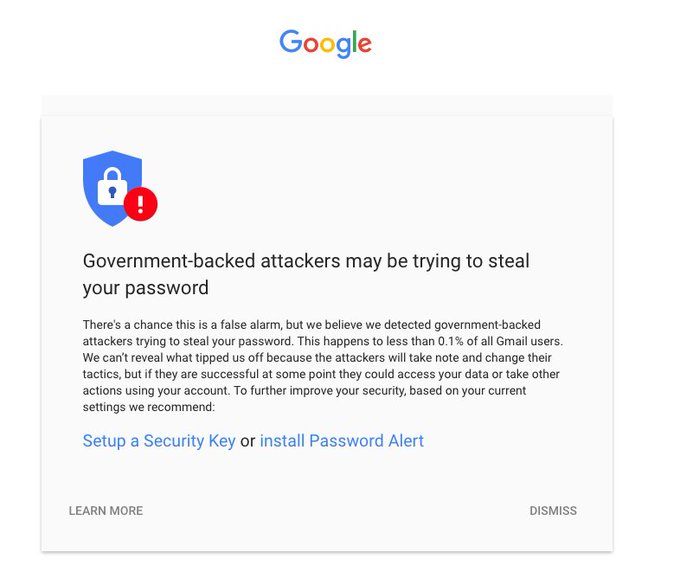
Google has raised a red flag to prominent journalists, professors and scientists with regards to their accounts being under state-sponsored attack. If the multiple reports circulating online are to be believed, then the instances have increased in the past 24 hours, though Google is known to send such warnings since 2012.
The list of people (via Arstechnica) includes Paul Krugman, the Nobel prize winning New York Times columnist, Michael McFaul who is a Standford University professor and also a former US diplomat, Keith Olbermann of GQ, Foreign Policy columnist Julia Ioffe, YNew York Magazine’s Jonathan Chait, among others.
Slowly, many other have started taking to Twitter to reveal the warning. The warning reads: “Google may have detected government-backed attackers trying to steal your password.”
“The warning may be related to a spear-fishing campaign, tied by a security company to the Russian government, that was started soon after Donald Trump won the US presidential election,” Neowin report points out.
Many others believe that Trump is doing exactly what he had planned and cracking down on what he believes is dishonest media.
Google is asking these users to further strengthen their account security with stronger passwords and two-factor authentication. The report, citing Google spokesperson, adds that the recent warnings could be due to the hacking attacks that took place last month. The report adds that Google doesn’t turn on the warning signal instantly as it could alert the attackers of the detection method.

Related Posts Plugin for WordPress, Blogger...