Saturday, November 12, 2016

Google pixel ,Apple safari and Microsoft edge hacked By 360 Alpha Team and walked away with $520,000 in prize money


Chinese teams kill Safari, laugh at four-second Flash hack


Power of Community The Google Pixel fell to a team of Chinese hackers alongside Apple Safari and Adobe Flash at the PwnFest hacking competition in Seoul on Friday.
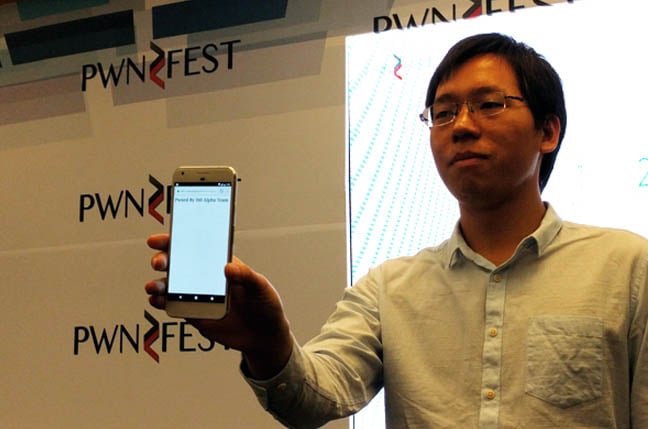
Mountain View's latest offering was smashed by white-hat friendlies from Qihoo 360, who used an undisclosed vulnerability to gain remote code execution for $120,000 cash prize.
The exploit launched the Google Play store before opening Chrome and displaying a web page reading "Pwned By 360 Alpha Team".
Google will now work on a patch for the flaw.
It was the second time in as many weeks that the Pixel has been compromised.
The Pixel, pwned
The first still-unpatched zero day was developed by Qihoo 360 rival Keen Team of Tencent at the Mobile Pwn2Own event in Japan.
Hackers there showcased the exploit at the PwnFest hacking event in Seoul today showing how they could compromise all aspects of the phone including contacts, photos, messages, and phone calls.
Play Video
 

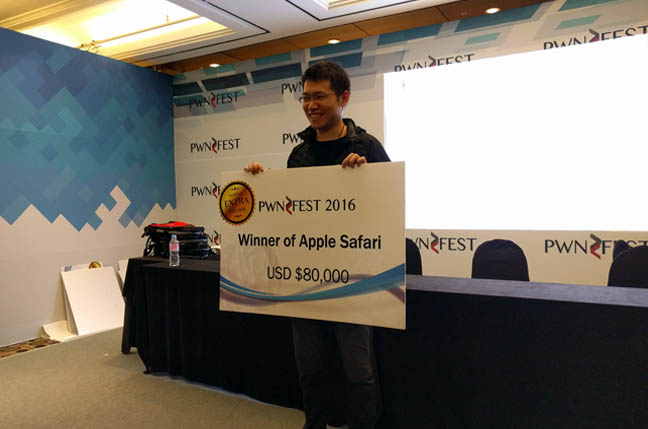
Apple's updated Safari browser running on MacOS Sierra also fell. Respected Chinese hacker outfit Pangu Team renowned for releasing million-dollar persistent modern iOS jailbreaks for free, along with hacker JH, blasted Cupertino's web browser with a root privilege escalation zero day that took 20 seconds to run, earning the team $80,000.
Qihoo 360 also breached Adobe Flash with a flick of the finger, digging up a combination decade-old, use-after-free zero day and a win32k kernel flaw to score $120,000.
It took four seconds for Flash to fall.
The hacks conclude the PwnFest whitewash, which saw Microsoft Edge hacked and the first-ever zero day exploits against VMWare Workstation on Thursday.
Qihoo 360 hackers walked away with $520,000 in prize money. ®

Friday, November 11, 2016

Global industry groups voice opposition to China cyber security law

Global industry groups voice opposition to China cyber security law

More than 40 international business and technology organizations representing hundreds of companies on Friday expressed “deep concerns” to the Chinese government about a new cyber security law they said would likely increase the separation between China and the rest of the world economy.
Beijing has adopted a cyber security law it called necessary to counter growing threats of hacking and terrorism.
The measure, to take effect in June 2017, was swiftly condemned by overseas critics, including business and human rights groups. They said it threatens to shut foreign technology companies out of various sectors deemed “critical”, and includes contentious requirements for security reviews and for data to be stored on servers in China.
Chinese officials have said it would not interfere with foreign business interests.
In their letter, the groups warned that Beijing’s efforts to control more of China’s Internet and technology would “effectively erect trade barriers along national boundaries” while failing to achieve its security objectives.
The cyber security law would also burden industry and undermine “the foundation of China’s relations with its commercial partners,” the groups wrote in a letter addressed to the Chinese Communist Party Central Leading Group for Cyberspace Affairs.
The letter’s signatories include the Information Technology Industry Council, the Internet Association, the U.S. Chamber of Commerce, the Australian Industry Group and BusinessEurope, among others.
The law’s adoption comes amid a broad crackdown by President Xi Jinping on civil society, including rights lawyers and the media, which critics say is meant to quash dissent.
U.S. Senator Cory Gardner, a Colorado Republican, told Reuters he was “extremely troubled” by the new law.
The measure “could further infringe upon the privacy of its people and potentially have a widespread impact on the international business community,” said Gardner, who chairs the Senate Foreign Relations Subcommittee on East Asia, the Pacific and International Cybersecurity.
Gardner said he voiced concern with Chinese officials about the law during a recent visit to the country and would press the Obama administration to address Beijing’s broader actions in cyberspace, “which threaten U.S. economic and national security.”
Reuters

HP announces interest-free EMI and zero down payment on purchase of laptops before 30 November

HP announces interest-free EMI and zero down payment on purchase of laptops before 30 November

In a move to help customers facing cash crunch owing to the demonetisation of Rs 500 and Rs 1,000 currency notes, HP India on Friday announced a 50-day payment holiday for its notebook customers.
This facility will be available under a special zero-interest EMI scheme and no down payment will be required at the time of purchase, the company said in a statement.
The customers can buy any notebook launched in 2016 and the payment of EMIs will start from January 2017.
“We want our customers not to face any challenge in buying HP notebooks and have a hassle free experience to own a HP notebook,” said Ketan Patel, Director, Personal Systems, HP India.
The scheme covers HP notebooks with the starting price of Rs 23,190 and will be available at designated 1,100 HP stores including exclusive HP World stores across the country.
The scheme will remain applicable till November 30.
PM Narendra Modi announced the demonetisation of Rs 500 and Rs 1,000 currency notes from the night of 8 November. Old currency will have to be exchanged or deposited at banks before 30 December. Digital Wallet services like FreeCharge and PayTM have seen a massive surge in the use of their services.
IANS

Oooh🚧Apple iPhone 7 Plus exploded like galaxy note7 after a 50 centimetre fall

#APPLE

An Apple iPhone 7 Plus reportedly exploded in China after a 50 centimetre fall
Image: Leikeji
By 
According to a report on Chinese web site Leikeji, the battery of a brand new iPhone 7 exploded, with the cracked screen violently separating from chassis. The Samsung Galaxy Note 7 fiasco lead to the largest fire and burn hazard related product recall in United States history. But with the iPhone 7 Plus, there seems to be a trigger to the explosion – a fall. Lithium based smartphone batteries are extremely volatile, and exposure to either moisture or heat can make them explode. This is what happens when you puncture a modern smartphone battery.
Unlike the Samsung Galaxy Note 7 explosions though, the reported incident in China was not a case of spontaneous smartphone combustion. The battery reportedly exploded after a fall. However, a fall of just 50 centimeters is not a large height, and is not an encouraging sign. The phone shocked the user, started emitting smoke, and then caught fire. The user apparently had opted to purchase an Apple iPhone 7 Plus, after reading news reports of exploding Samsung Galaxy Note 7 smartphones.
exploding-apple-iphone7
In August, a man riding a motorcycle in Australia got the shock of his life when he fell off his bike and his iPhone exploded in his pocket. The heat fused the model to his leg, and he had to punch the phone free. In September an iPhone apparently exploded while still in the box. There were no follow up posts or information after the initial reddit post, but the user manual in the box indicates that the phone was not the latest iPhone 7. In October, an iPhone 7 wrapped in clothes and kept in the back seat of a closed car in a sunny beach, caught fire because of the heat. The entire vehicle was engulfed in flames.
By comparison, over 30 Samsung Galaxy Note 7 incidents were reported over the last week in August.

Did Trump secretly employ Data Analytics for success?

Did Trump secretly employ Data Analytics for success?

REUTERS/Joshua Roberts - RTX2T3F7
By Muqbil Ahmar
With Donald Trump becoming the next Republican President-Elect, there is no reason to throw Data Analytics out of the window. His win doesn’t necessarily mean Data Analytics, whose role was established for correctly predicting results during Barack Obama’s 2012 election, is all hogwash. A closer scrutiny of what’s and why’s and putting the dots together can solve the puzzle. From the beginning Trump dumped all data strategies in public. While others entered into partnerships with data strategists, Trump didn’t. He, in fact, criticised the role of data analytics in predicting the outcome.
“I’ve always felt it [Big Data] was overrated. Obama got the votes much more so than his data processing machine. And I think the same is true with me,” he claimed, leading his opponents to berate his data strategies. However, these were purely his claims. He kept everyone under the illusion. In the last moments before the vote it came to be known that Trump had indeed hired a little known analytics company in the UK to provide him data insights. The two had been working for quite some time.
Trump secretly hired British Analytics firm
In the month of September alone, Trump paid British firm Cambridge Analytica $5 million to help target voters. The company claimed it had data on around 230 million adults in the USA and approximately 4000 “data points” on every one of them, including gym and club memberships, charity donations, and card transactions. Trump’s win is confirmation that the data strategy of the British company, which is based on a hyper-targeted psychological approach, has worked. Only some days before the election, the London-based company witnessed an increase in support for Trump: from 1 to 3% in states like Pennsylvania, Ohio, Michigan and Wisconsin.
The firm, which helped the Leave.EU group before the EU referendum in the United Kingdom, utilizes a psychological approach to decipher trends. They analyze data from diverse source: credit card histories, social media, consumer data, purchase history, voting records, supermarket loyalty schemes, phone calls, Facebook surveys and go even as far as documenting TV-watching habits. The data resulted in around 20 models that were constantly updated in real time as the database evolved. “What gave us advantage over the other polling companies is how quickly we were able to react by updating models to take into account where the demographic is shifting,” said Matt Oczkowski, director of product at Cambridge Analytica, in an interview.
Data Analytics evolves fast. “Over the last four years, companies have sharpened Big Data tools, adding Artificial Intelligence, Predictive Analytics, Sentiment Analysis, Machine Learning, and Language Processing to the mix. As far as I see it, Cambridge Analytica’s data strategy paid off,” said Shashank Dixit, CEO, Deskera, a cloud technology firm that also has a Big Data Analytics tool.
Why the shroud of mystery?
That Trump banked heavily on the British firm is evident due to three reasons: (a) he chose a company across the Atlantic, when most of them are based in the USA itself? (b) Till the last minute nobody knew of the arrangement. (c) Trump kept on rubbishing the role of data analytics. Why should there be secrecy around the firm if Trump didn’t think much of it? Now, all this seems like a well-calibrated strategy on the part of the wiley American. He kept his cards close to his chest till the last. He wanted his opposition to underestimate his strategy. The results show that the billionaire businessman clearly outwitted his opposition by utilising data analytics surreptitiously.
By the time it came out into the open, it was too late. But even if Clinton’s analytics team had known it earlier, they wouldn’t have taken it seriously. Just before the elections, a Clinton aide said: “We really have no idea what Trump is or isn’t doing. We are confident on where campaigns and organisations on the Democratic side of the spectrum are in terms of its analytics capabilities, but it’s important that we continue to innovate and that we can’t worry about what groups on the right are/aren’t doing.”
Trump’s ingenuity has certainly paid off. It was a masterstroke. This piece is not to undermine his appeal with the voters, the final factor which decides the winner. What this could signal is the beginning of a race for sharper more sophisticated tools that are being developed in the remote corners of the world. But all said and done, predicting human actions for such large number of people would always be a puzzle.
With over 10 years of experience in the field of journalism, the author is a technology evangelist and avid blogger.

Alibaba Singles Day sale transactions surpass $13.6 billion with 9 hours to go

Alibaba Singles Day sale transactions surpass $13.6 billion with 9 hours to go

Image Credits: Reuters
Alibaba Group Holding Ltd’s Singles’ Day sales surged past last year’s 91.2 billion yuan ($13.36 billion) total with nearly nine hours left on the clock, but growth was markedly slower than in 2015 as shoppers sought even bigger price cuts.
Amid fanfare and celebrity razzmatazz, sales on Alibaba’s platforms had raced to a billion dollars in under five minutes and within the first sixty minutes had passed $5 billion – a third faster than 2015 as the e-commerce giant looked to shrug off a domestic economic slowdown and a U.S. accounting probe.
The 24-hour event held annually on Nov. 11 offers a benchmark for Alibaba’s performance and an insight into China’s swing to online shopping, especially via smartphones. Launched in 2009, Alibaba’s version of the event was designed to encourage consumers without a partner to treat themselves.
The discount shopping day, also known as “Double 11”, still shifts more goods than Black Friday and Cyber Monday in the United States combined. Sales on Alibaba platforms, including Tmall and Taobao, are tipped to exceed $20 billion this year.
“Back in 2013, 35 billion yuan ($5.14 billion) was our one-day GMV (gross merchandise volume),” said Chief Executive Officer Daniel Zhang in a live microblog posting on Alibaba’s event. “Now we can achieve it in one hour.”
GMV refers to the value of goods sold by vendors through Alibaba’s platforms. Alibaba makes money through advertising and charging vendors a proportion of their sales.
Mobile shopping surge
After a beefed-up marketing push over the last month – with fashion shows and virtual reality games – sales officially opened at midnight, releasing a wave of pre-orders that shoppers had placed ahead of the event. Sports stars David Beckham and Kobe Bryant attended the countdown, though headline act Katy Perry pulled out last minute citing a “family” issue.
At 1519 p.m. (0719 GMT) a live sales tracker at Alibaba’s main event in the southern Chinese city of Shenzhen passed the 2015 yuan total, ensuring the day will set a new record but, in dollar terms, was still short of 2015’s $14.3 billion.
The rise of Singles’ Day reflects how China’s consumers, armed with smartphones, are racing online to shop – to the detriment of bricks and mortar stores. So far on Friday, 83 percent of sales were via mobile devices, up strongly from last year, Alibaba said.
The day itself is a double-edged sword for many: Couriers, packaging firms and vendors say low prices and steep competition mean profit margins are slim despite large sales volumes. Cut-throat competition for customers has also caused concern over false advertising and massaged statistics. This week China’s business regulator advised mainland online shopping platforms to guard against suspect sales tactics.
In May this year, Alibaba said the U.S. Securities and Exchange Commission (SEC) was looking into how it reports its Single’s Day figures. Alibaba said at the time it was cooperating with the authorities, and that the SEC advised it the investigation should not be seen as an indication the company had violated federal securities laws.
Alibaba declined to comment on the SEC probe on Friday. Alibaba is not the only retailer to mark Nov. 11 with a massive sales drive. China’s no. 2 e-commerce player JD.com Inc and many others also offer discount deals on the day.
Reuters

WhatsApp adds Two Step Verification to Android along with other new features

WhatsApp adds Two Step Verification to Android along with other new features

Image Credit: WhatsApp
By 
WhatsApp is rolling out an update that adds Two-Step Authentication to your WhatsApp account. This feature is an essential method to ensure the safety of your WhatsApp account. WhatsApp had been internally testing this feature since last few months to finalise the exact implementation of the security countermeasure with reports going back to July.
WhatsApp Two-Step Verification
Two-Step Authentication, named as “Two-step verification” is located under the Account section on the main “Settings” menu. This adds a passcode to your WhatsApp account which is required for every time you register your contact number with WhatsApp number. The setup process is simple where you only need to tap on the option and follow the instructions. The setup asks you to enter a six-digit passcode and verifies the code. It also gives you the option to enter an email address as a backup to reset the passcode if you forget the passcode or misplace it.
WhatsApp Two-Step Verification
WhatsApp Two-Step Verification Setup
You can skip entering the email address but skipping a backup method is not recommended as losing the passcode will lock you out of your WhatsApp account. Once the setup process is completed, the “Two-step Verification” gives you easy options to ‘Disable’, ‘Change passcode’ or ‘Change email address’.
WhatsApp GIF Search
Search GIF’s straight from the keyboard
This new feature is available on the latest WhatsApp Android Beta version. You need to enrol in WhatsApp Beta program from Google Play Store WhatsApp listing page. This comes right after the company launched GIF Search for Android along with the ability to convert Live Photos as GIFs for iOS.
WhatsApp Live Photos GIFs
Convert Live Photos into GIFs
The developers for the platform have consistently been trying to introduce new features after the introduction of the official WhatsApp Beta program for Android. The company has added a new “Status” tab to mirror the functionality of destructible images or videos like ‘Snaps’ in Snapchat.

Related Posts Plugin for WordPress, Blogger...