Thursday, February 9, 2017

Galaxy Note 7 battery supplier Samsung SDI factory in China catches fire

Galaxy Note 7 battery supplier Samsung SDI factory in China catches fire

By 
The factory of Samsung SDI, one of the battery suppliers for the dangerously explosive Samsung Galaxy Note 7, caught fire in China. Pictures of the fire were circulated on Weibo, a social networking and micro-blogging platform known as the Chinese alternative to Twitter. The fire was relatively minor, was at a waste disposal facility, and did not affect production, according to a report in Bloomberg.
Samsung SDI was responsible for providing about 60 percent of the batteries to the discontinued Samsung Galaxy Note 7 smartphones, the other supplier being Amperex Technology Ltd. Following the explosions of the smartphones, Samsung SDI investigated their batteries in other smartphones, and found them to be safe. Samsung SDI is expected to provide at least a portion of the batteries in future Samsung phones. An executive of the company said that the issue was restricted to just the batteries used in the Galaxy Note 7.
Samsung recently revealed the results of its investigation into the cause of the Samsung Galaxy Note 7 fires. The company identified the battery as the problematic component that caused the fires. Independent investigations have showed that the body of the smartphone, and its curvature, left little space for natural expansion and contraction of the batteries, compressing them when charged and leading to the fires. South Korea also investigated the issue, and is fortifying the regulations for lithium-ion batteries, in the interest of consumer safety.

50,362 cyber security related incidents were logged in 2016, says CERT-In

50,362 cyber security related incidents were logged in 2016, says CERT-In

Image Credit: Venture Beat
Over 50,300 cyber security incidents like phishing, website intrusions and defacements, virus and denial of service attacks were observed in the country during 2016, Parliament was informed today. “As per the information reported to and tracked by Indian Computer Emergency Response Team (CERT-In), a total number of 44,679, 49,455 and 50,362 cyber security incidents were observed during the year 2014, 2015 and 2016, respectively,” Minister of State for Electronics and IT P P Chaudhary said in a written reply to Lok Sabha.
He added that the types of cyber security incidents included phishing, scanning/probing, website intrusions and defacements, virus/malicious code and denial of service attacks. “With the proliferation of Information Technology and related services, there is a rise in instances of cyber crimes in the country like elsewhere in the world,” he said.
As per the data maintained by National Crime Record Bureau (NCRB), a total of 5,693, 9,622 and 11,592 cybercrime cases were registered during the years 2013, 2014 and 2015, respectively, showing a rise of 69 per cent during 2013 to 2014 and 20 per cent during 2014 to 2015. “This includes cases registered under the IT Act, 2000 and related sections of Indian Penal Code and Special and local laws involving compouter as a medium/target. Similar data for the year 2016 is under collection,” he said.
Also, RBI has registered a total of 9,500, 13,083, 16,468 and 8,689 cases of frauds involving credit cards, ATM/debit cards and internet banking during the year 2013-14, 2014-15, 2015-16 and 2016-17 (upto December 2016), respectively. Further, CBI has registered a total of 87 cases during 2014 to 2016. Out of these 87 cases, charge sheets have been filed in 36 cases, status report filed in copmpettent court in 4 cases, 6 cases were closed and 41 cases are under investigation by CBI.
Besides, 4,699 and 6,266 cases were registered during the year 2014 and 2015, respectively for stalking women (Section 354D IPC) during 2014-15, as per data maintained by NCRB. This is a rise of 25 per cent during 2014 to 2015. The Minister said a total number of 28,481 websites were hacked in 2013, 32,323 (2014), 27,205 (2015) and 33,147 (2016).
“It has been observed attacks are launched through compromised computer systems located in different parts of the world. Masquerading techniques and hidden servers are also used to hide the identity of the actual systems being used by malicious actors,” he said. The attacks are observed to be originating from various countries including China, Germany, Hong Kong, Japan, Malaysia, Pakistan, Romania, the UK, the US, Syria, the UAE and Italy, he added.
PTI

Microsoft is now selling Surface Hub as a service, and has introduced a try before you buy option

Microsoft is now selling Surface Hub as a service, and has introduced a try before you buy option

By 
In the nine months since the Surface Hub has launched, 2,000 customers have ordered the device in 24 markets. Each order ranged from one to 1,500 units, and Microsoft is gearing up for 2017 by introducing new ways to purchase the device, considering the strong demand for the product.
A survey by IDC shows that 73 percent of businesses hope to move to a subscription based model for IT procurement over the next three years. Customers in the UK will be able to get Surface Hubs soon from Microsoft’s partner, Maverick. There are twenty six partners spread across Europe, Asia, US, Canada and the UK. Microsoft is also launching the Surface Hub Value Added Distributors Program for Opportunity Resellers (VAD-OR) program, to allow Surface Hub distributors to deliver the same quality of service to opportunity resellers.
Jon Sidwick, VP of Maverick Europe, says, “This service is a real channel game changer for the collaboration market. Many companies offer various forms of leasing; our process will be far more sophisticated and accessible. We will be kicking off this service in partnership with Microsoft this year on a country by country basis to offer Surface Hub as a Service. This will enable resellers to access a subscription model then only have the Hub in place for as long as they need. The successful implementation of this type of program will create a far quicker sales cycle with more sophisticated solutions.”
Additionally, the Surface Hub will also be available as a try and buy product in certain markets through select retailers. Customers will be able to use a Surface hub for 30 days before placing an order. The program is intended for enterprise clients to try out a device before placing large orders.

Apple’s BeatsX wireless earbuds to launch this week

#APPLEApple’s BeatsX wireless earbuds to launch this week

By 
US tech giant Apple announced that BeatsX wireless earbuds will be available globally later this week.
BeatsX earphones deliver up to eight hours of battery life and with “Fast Fuel”, a five-minute charge gives you two hours of playback.
“The earbuds come with unique flex-form cable that provides all-day comfort and easy pocket portability, while eartip options provide a personalised fit and secure-fit wingtips offer added stability,” Apple said in a statement.
BeatsX features optimised noise isolation, RemoteTalk allows you to take calls with a built-in mic, play music, adjust volume and activate Siri and also comes with variety of eartip options to offer personalised comfort.
The BeatsX headphones use Apple’s proprietary W1 audio chip to deliver audio wirelessly from the iPhone 7 and 7 Plus models. The chip also allows for a seamless set up and come with a lightning connector on the cable. The port works works with Beats Audio’s Fast Fuel charging technology that will allow users up to 2 hours of playback with with just 5 minutes of charging.
The headphones are priced at 149.95 USD which is roughly Rs 10,000. This pegs them below Apple’s pricey AirPods that currently retail in India at Rs 15,000.
With inputs from IANS

Tuesday, January 31, 2017

Xiaomi Redmi Note Pro 2 leaks, could get improved dual-pixel AF camera and battery

Xiaomi Redmi Note Pro 2 leaks, could get improved dual-pixel AF camera and battery

By 
Xiaomi announced the Redmi Pro in China last year with a dual-camera setup and an OLED display. The company restricted the handset to its hometown and now it seems that a successor is on its way.
Thanks to a leaked slide, we now have info on what could be the Redmi Pro 2. The smartphone will come with a brushed metal finish at the back and skip the dual-camera for a single lens with improved specs. It will feature a new sensor, the 12MP Sony IMX 362. This is a 1/2.55” sensor with large 1.4µm pixels and Dual Pixel autofocus. On paper it should be better than the 1µm pixels that are on the Mi Note and Mi Mix.
Other features include a larger 4,500mAh battery which is an up from 4,050mAh unit. Expect two storage and RAM variants including one with 6GB of RAM and 128GB of storage which could cost CNY 1,800 (Rs 18,000 approx). The other one would be a 4GB RAM and 64GB storage which would be the base version priced at CNY 1,600 (Rs 16,000 approx). The pricing sounds better than what it was on the original Redmi Pro which retailed at CNY 2,000 (Rs 20,000 approx) for the 128GB variant. There is no info on the chipset but we are assuming a MediaTek chipset, possibly a new Helio SoC.
Expect more leaks and rumours in the near future, so stay tuned.

Trump executive order: Google employees’ protest, sends across a strong point

Trump executive order: Google employees’ protest, sends across a strong point

Image: Reuters
By 
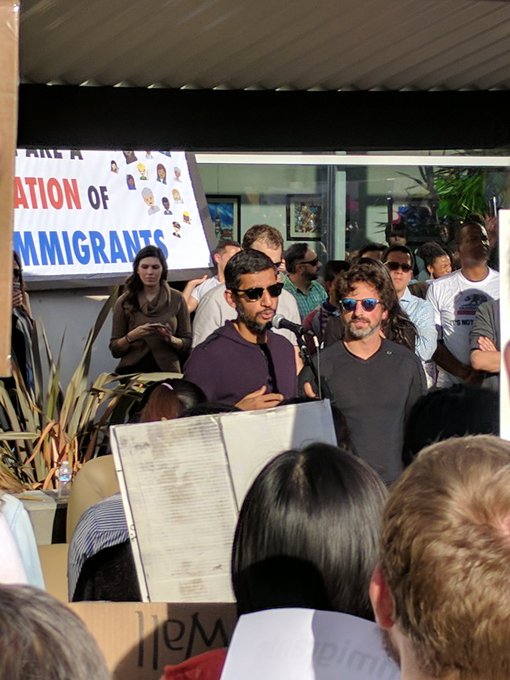
Google is one of the most influential internet companies in the world and part of a tech conglomerate Alphabet. It is also a company whose employees have been quite vocal in their criticism of the executive order that was passed by Trump targetting immigrants. Sure, a lot of tech CEOs raised their voices against the order. We have a whole list here. But in the case of Google, it is not only the CEO, but also a co-founder, former CEO as well as the Google employees themselves, who have made their stand clear over the last few days.
Walking the talk
Pichai in an email to staff said the US ban on foreign nationals from seven Muslim-majority countries will hit at least 187 Google employees.
“We are upset about the impact of this order and any proposals that could impose restrictions on Googlers and their families, or that could create barriers to bringing great talent to the US,” the Wall Street Journal quoted Pichai as saying in the email. “It is painful to see the personal cost of this executive order on our colleagues,” he said.
Google co-founder Sergey Brin, whose family immigrated to the US in 1979 from the then Soviet Union, took part in the protests taking place at the San Francisco international airport. While protesting in his personal capacity, Brin said that he was protesting because he himself was a refugee.
Recently at a meeting with Google employees, Eric Schmidt, the executive chairman of Alphabet said “that the Trump administration is going to do evil things as they’ve done in the immigration area and perhaps some others.” Schmidt did say that the government is focussed on economic growth in his meeting with employees. He said that these ‘evil things’ will be done while keeping the focus on the growth rate in the US by increasing federal spending.
According to reports, there were about 2000 employees participating in the protest on 30 January, and these included Google top brass like Sundar Pichai and Sergey Brin, both of whom are technically immigrants.
Google has also set up a $4 million fund for immigrants. This fund includes $2 million contributed by Google’s own employees. All things point to the fact that Google employees, while not in the official capacity, are taking a political stand by their actions and gestures.
Wooing the Republicans
It is no secret that Google backed Democrat candidate Hillary Clinton during the Presidential elections. But the company has since been trying its best to get into the good books of the Trump administration as well. According to Bloomberg Google had sought a ‘DC veteran to act as liaison to conservative, libertarian and free market groups’.
Image: Reuters
Image: Reuters
However, Google / Alphabet have made it public whenever it has met with Trump. For instance, when Trump met with the top tech CEOs from Silicon Valley, Larry Page was present. More recently, even Eric Schmidt had met the president at the Trump Tower. According to Buzzfeed, Google states that it was better to work behind the scenes with the administration, rather than making statements which would antagonise people from the administration with whom Google / Alphabet has to work.
Schmidt has also stated to his employees that he did all he could in his power to dissuade the administration from taking an anti-globalisation and discriminatory stand on the immigration order, but nothing has come out of it.
AP
Image: AP
Pichai has also tried to explain why it is counterproductive for Google as a company to take a stand officially. In a statement to Vice News, Pichai said, “If you publicly take a strong position, once they’ve identified you’re completely on one side, you lose the ability to come to a rational position. We get very strong reactions when we try to reach out to the other side. Taking public positions is productive in some cases, and counterproductive in others.” According to a New York Times report, Google also recently organised an event for Republican lawmakers.
Treading a fine line
While on the one hand Google and Alphabet employees are protesting against the controversial executive order, on the other hand, it is trying to be in the good books of the Trump administration as well. In doing so, Google and its parent company Alphabet are trying to find a right balance between its employees putting forth a resistance against unfair orders, at the same time not antagonising the government in the official capacity.
At the end of the day, a lot of Google and Alphabet’s projects require government co-operation. So it is treading a path which any profit-making institute would take.
Targetting immigrants from certain nations based on religious lines, specially when a lot of the top US companies have been built by immigrants, smacks of arrogance. It is then heartening to see employees of the Silicon Valley tech giants taking to the streets to protest against this unfair executive order.
Whether the companies or its employees would be punished for these protests, is something only time will tell. But if there are penalties to be paid, then that would set a wrong precedent.

Apple shuts Activation Lock checker tool, makes buying used iOS devices risky

Apple shuts Activation Lock checker tool, makes buying used iOS devices risky

Image Credit: Amazon
By 
Apple is said to have removed the Activation Lock tool on the iPhone, iPad and the iPod. With this feature, users could check the ownership status of any of the above mentioned devices.
This tool allowed users to enter the serial number or IMEI of an iOS device to find out if the activation lock was active or not. This helped consumers who were interested in purchasing used devices avoid stolen ones. It has been removed from the iCloud web page as well which now leads you to a ‘404 Not Found’ page.
Apple hasn’t mentioned as to why exactly it is shutting down the Check Activation Lock Status feature. There is a possibility that the company took the decision due to some security or privacy risk, or maybe there aren’t enough people who are actually using this feature.
Last year, a Kerala based security researcher had identified a bug running in iOS 10.1 that allowed him to bypass the activation lock on an iPad. Hemanth Joseph bypassed the activation lock in a locked iPad by finding a weakness in the device setup process running on iOS 10.1. The bug which was discovered by Joseph was reportedly fixed in an iOS update later.

Related Posts Plugin for WordPress, Blogger...