Showing posts with label Mark Zuckerberg. Show all posts

Tuesday, March 21, 2017

Bill Gates has once again topped the list of world’s richest in Forbes magazine

BILL GATESBill Gates has once again topped the list of world’s richest in Forbes magazine

(Image: Reuters)
By 
Microsoft co-founder Bill Gates once again topped the Forbes magazine list of the world’s richest billionaires, while US President Donald Trump slipped more than 200 spots, the magazine said Monday. Gates, whose wealth is estimated at $86 billion, led the list for the fourth straight year.
He was followed by Berkshire Hathaway chief Warren Buffett among the top 10 billionaires, a group heavily dominated by Americans, many of whom work in the technology sector. Buffett’s wealth was estimated at $75.6 billion. Others in the top 10 included Amazon founder Jeff Bezos at number three, Facebook creator Mark Zuckerberg at number five and Oracle co-founder Larry Ellison at number seven.
The global billionaire population jumped 13% from last year to 2,043, the biggest annual increase in the 31 years since the magazine began compiling the list, Forbes said. The US led countries with the most billionaires with 565, a product of the swelling value of the American stock market since Trump’s November 2016 election. China was second with 319 billionaires, and Germany was third with 114.
Trump himself slipped 220 spots on the list to number 544 with an estimated $3.5 billion. Forbes attributed Trump’s drop to sluggishness in the Manhattan real estate market which is responsible for a disproportionate amount of his wealth. “Forty percent of Donald Trump’s fortune is tied up in Trump Tower and eight buildings within one mile of it,” Forbes said. “Lately, the neighborhood has been struggling (relatively speaking).”
Among others in the Forbes top 10, Amancio Ortega of Spanish apparel chain Zara was fourth, Mexican telecom tycoon Carlos Slim was sixth, the Koch brothers, Charles and David, were eighth and ninth and former New York City mayor and Bloomberg News founder Michael Bloomberg was 10th. This year it took at least $3.7 billion in wealth to make it onto the list, but only in a tie for 501th place, a group that included Hollywood director Steven Spielberg.

Saturday, February 18, 2017

Mark Zuckerberg talks of using Facebook to transform the world in his ideologically charged treatise

Mark Zuckerberg talks of using Facebook to transform the world in his ideologically charged treatise

Image: Reuters
By 
“Are we building the world we all want?” That’s the question Facebook CEO Mark Zuckerberg is asking us in his treatise titled ‘Building Global Community.’
Addressed to the community, the entire 6,000 word manifesto talks about Zuckerberg’s plan of transforming Facebook into supportive, safe, informed, civically-engaged and inclusive, global community. He talks about history bringing people together, of building social infrastructure to “empower us to achieve things we couldn’t do on our own.”
He says, “Our greatest challenges need a global response” and that, “Progress now requires humanity coming together not just as cities or nations, but also as a global community.”
That community, Zuckerberg believes, is Facebook. He states that Facebook has so far focussed on connecting friends and families, but that now, it will focus on “developing the social infrastructure of community.” He adds that Facebook is a work in progress, that learning and improving is simply a part of the culture.
To achieve this, Zuckerberg will now align Facebook around the building of communities. Communities that are “supportive safe, informed, civically engaged and inclusive.”
Zuckerberg intends to build an idealistic world, and to that end, I’m very much in favour of his vision. However, I don’t trust Facebook to actually take responsibility for doing the right thing.
Facebook is a company, not an NGO
Facebook is a company first, a community leader only incidentally. As a company it’s built around only one concept, making profits. It will work for the greater good of the community only if that work translates to the greater good of Facebook’s shareholders.
Image: Reuters
Image: Reuters
While Zuckerberg’s mission statement paints a pretty picture, we must not forget that it’s Facebook’s actions up till now that have led to the rise of Trump, the proliferation of fake news at a global scale and the filter bubbles that Facebook’s algorithms encouraged, however unintentional those actions were.
As Medium’s Frederic Filloux so eloquently explains in a blog post, “Facebook is above all an advertising machine. A fantastic one.”
He explains that Facebook’s revenue system is built around page views and sharing and that, “Sharing is key because it leads to higher page consumption which, in turn, leads to multiple bespoke advertising exposures.”
To achieve this, Facebook’s algorithms fine-tune what you see based on your interests. Facebook ensures that you stay in a comfort zone that it’s algorithms build for you. You will not be shown posts that are contrary to what Facebook’s algorithms determine are your beliefs.
In other words, you will not be shown posts that you wouldn’t “like”.
Facebook created the ultimate filter bubble
It’s not that we’re intentionally saying that we don’t want to see the real world. Facebook determined that it didn’t want to show us the bigger picture. We weren’t really given a choice in the matter. Facebook is indirectly shaping our thoughts.
I’m not accusing Facebook of deliberately bringing Trump to power or encouraging fake news. No, Facebook did none of those things. However, Facebook has left us at the mercy of Zuckerberg’s view of the world.
Image: Reuters
Image: Reuters
As Adam Mosseri, VP of Product Management for News Feed himself said, “We are in the business of connecting people and ideas — and matching people with the stories they find most meaningful.” He’s oblivious of the fact that he is, in effect, describing a filter bubble.
Filter bubbles are bad because they isolate us in our own cultural and ideological bubbles.
“Facebook is also incredibly effective at weakening the norms that hold real-world communities together,” says Wired.
Fake News and community responsibility are only a problem now because Donald Trump is in power. If Hillary Clinton was president, we wouldn’t have heard a peep from Facebook.
Filloux says it best when he says, “Facebook will solve just enough of the fake news to put down the raging PR fire. But the company will never jeopardise its money machine for the sake of mere societal considerations.”
So what’s Zuckerberg’s plan?
Facebook has always been a bunch of fractured, isolated communities that reside on a common platform. While Facebook encourages interaction with friends and family, it has so far actively discouraged interaction between rival communities.
Zuckerberg wants to fix this and he wants to start by bringing people from like-minded communities together and improve discourse.
“Research suggests the best solutions for improving discourse may come from getting to know each other as whole people instead of just opinions,” writes Zuckerberg.
Image: Reuters
Image: Reuters
The plan is to bring diverse communities together, not on ideology, but on interests. Cricket fans and football fans coming together with other sports communities, for example. Zuckerberg wants to build a platform that will enable better communication among these communities so people will get to know each other. These platforms will then be used to encourage discourse on topics that matter. This includes civic responsibility, being more inclusive, etc.
Fighting fake news is also a big concern. For a start, Facebook will start using a combination of big data, AI and human curation to cut down on sensationalist stories. It’s easy to determine sensationalist stories, writes Zuckerberg, because people usually share the headlines without reading the content.
If people read the content and share it, such a story, and its publisher, will be ranked higher than one that’s shared without reading.

Wednesday, January 25, 2017

Facebook CEO Mark Zuckerberg has no plans to run for US Presidential elections

Facebook CEO Mark Zuckerberg has no plans to run for US Presidential elections

Shelving rumours surrounding his plans to run for the US presidency, Facebook CEO Mark Zuckerberg has insisted that for now he has no such intentions, saying he would continue to work to grow his company. For now, he said he would continue working on growing his company as well as the Chan Zuckerberg Initiative (CZI) – the corporation he and wife Priscilla built which makes investments in scientific and leadership research.
According to Buzzfeed, Zuckerberg responded with a “No” when he was asked if he had any plans to run for president. “I am focused on building our community at Facebook and working on the Chan Zuckerberg Initiative,” he was quoted as saying on Tuesday. A source said that the Facebook founder has privately denied it as well.
“There’s absolutely no truth to the idea that Mark is running for office and I’ve heard it directly from him,” the source was quoted as saying. “Here’s the thing: For Mark, Facebook is global community that already plays this huge part in the lives of billions of people around the world and plays an incredibly important role in shaping the base on the issues that matter,” the source added.
IANS

Wednesday, November 16, 2016

Mark Zuckerberg’s Pinterest and Twitter accounts hacked by Ourmine

Mark Zuckerberg’s Pinterest and Twitter accounts hacked by Ourmine

By 
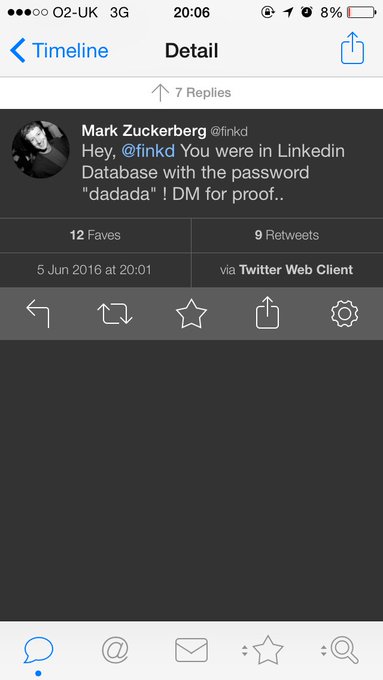
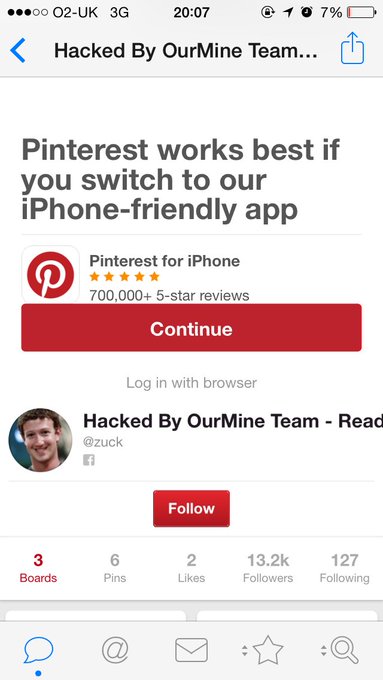
Ourmine, a hacking group that targets high profile entities has hacked Mark Zuckerberg. The group posted an update on its site, revealing the old and new Twitter passwords of Mark Zuckerberg. After the previous hack, Zuckerberg has added two factor authentication to his Twitter account. The Pinterest page of Zuckerberg was defaced with the group claiming the hack, and a link back to their site.
ourmine-hacks-zuckerberg-01
This is the second time this year that Ourmine has hacked Zuckerberg. In June this year, Ourmine had hacked the Twitter and Pinterest accounts owned by Zuckerberg. Ourmine claims to have used private methods for the hacks, not related to database leaks. However, there was a massive breach of Pinterest two years ago, and the Linked in password dump was used previously by Ourmine to compromise accounts held by Zuckerberg. This is what the previous hack looked like:
Following the defacing, Ourmine emailed a CNet reporter informing him of the hack. Ourmine had also claimed that the Instagram account held by Zuckerberg was compromised. However, in a statement that Facebook gave to VentureBeat, there seems to be no such intrusion. The compromised accounts have been restored, and the defacement removed.
Ourmine also peddles security services
Previously, Ourmine had hacked Buzzfeed news and left cryptic messages on the site. Ourmine compromised the Quora account of Google CEO Sundar Pichai. At the height of the PokĂ©mon GO craze, Ourmine claimed to have launched a dedicated denial of service attack against the PokĂ©mon GO servers, but the servers were struggling because of legitimate traffic itself. Ourmine compromised the Twitter account of Twitter CEO Jack Dorsey. Ourmine has also compromised the Twitter account of ex Twitter CEO, Dick Costolo. Ourmine apparently wants to increase awareness about information security with the string of high profile hacks.

Sunday, November 6, 2016

Facebook under investigation in Germany for failing to remove racist posts

Facebook under investigation in Germany for failing to remove racist posts

German prosecutors are investigating Mark Zuckerberg and other Facebook executives, a spokesman for the Munich prosecutor’s office said on Friday, following a complaint alleging the company broke national laws against hate speech and sedition by failing to remove racist postings.
The spokesman declined to provide further details. German attorney Chan-jo Jun had filed a complaint with prosecutors in the Bavarian city in September and demanded that Facebook executives be compelled to comply with anti-hate speech laws by deleting racist or violent postings from its site.
Facebook’s rules forbid bullying, harassment and threatening language, but critics say it does not do enough to enforce them and has failed to staunch a tide of racist and threatening posts on the social network during an influx of migrants into Europe.
Prosecutors in Hamburg earlier this year rejected a similar complaint by Jun on the grounds that the regional court lacked jurisdiction because Facebook’s European operations are based in Ireland.
“There is a different view in Bavaria,” his firm Jun Lawyers of Wuerzburg in Bavaria said in a statement.
“Upon Jun’s request, Bavarian Justice Minister Winfried Bausback said that Hamburg’s view was wrong and German law does indeed apply to some of the offences,” it said.
Jun’s complaint named Facebook founder and chief executive Zuckerberg and nine other managers at the company, including Chief Operating Officer Sheryl Sandberg.
Facebook said it had not violated German law and was working on fighting hate speech online.
“We are not commenting on the status of a possible investigation but we can say that the allegations lack merit and there has been no violation of German law by Facebook or its employees,” a company spokesman said.
Jun has compiled a list of 438 postings that were flagged as inappropriate but not deleted over the past year. They include what some might consider merely angry political rants but also clear examples of racist hate speech and calls to violence laced with references to Nazi-era genocide.
Following a public outcry and pressure from German politicians, Facebook this year hired Arvato, a business services unit of Bertelsmann, to monitor and delete racist posts.
A rash of online abuse and violent attacks against newcomers to Germany accompanied the influx of hundreds of thousands of migrants last year, which led to a rise in the popularity of the anti-immigrant Alternative for Germany (AfD) party and has put pressure on Chancellor Angela Merkel.
Reuters

Tuesday, November 1, 2016

Facebook attempts at owning Snapchat-like Snow, but fails yet again

Facebook attempts at owning Snapchat-like Snow, but fails yet again

Image Credit: REUTERS
By 
Facebook is obsessed with Snapchat! And, this obsession has no end. We’ve almost forgot the count of Facebook either trying to emulate or acquire a Snapchat-like app.
From Slingshot to WhatsApp stickers and just about everything in between. A new report claims that Facebook had tried acquiring Snapchat-like service from Naver called Snow. It made an unsuccessful bit at acquiring the Korean firm who also owns Line which is valued at $25 billion, reports Techcrunch.
However, the cash as well as a reported personal phone call from Mark Zuckerberg wasn’t enough to woo the firm. Snow has 80 million downloads, and keeps adding 10 million each month, according to report. This pretty much explains the world’s biggest social network’s interest in acquiring the app.
In the past few years, Facebook has clearly shown its fascination for the ephemeral app, that it has set it heart on, for long now.
Meanwhile, Snapchat has been wooing younger audiences, raking in a high number of video views and so on, with a user base that is smaller than Facebook.
Its parent company, Snap Inc, is also working on an initial public offering that could value the company at $25 billion or more. Snap Inc, which operates the app that lets users send videos and messages that disappear in seconds, is looking to sell shares as early as late March. Morgan Stanley and Goldman Sachs are believed to lead Snapchat IPO.

Thursday, October 6, 2016

OurMine hacks Buzzfeed in retaliation for publishing details of alleged member


By Rob Thubron on October 6, 2016, 12:30 PM


You may be familiar with the name OurMine. The group has been responsible for several high-profile hacks of celebrities and some of the most famous CEOs in the tech industry, including Facebook’s Mark Zuckerberg, Google’s Sundar Pichai, and Uber’s Travis Kalanick. Now, the hackers have hit BuzzFeed in retaliation for an article that exposed one of its alleged members.

Joseph Bernstein’s investigation identified Saudi teenager Ahmed Makki as a member of OurMine. The group denied this, claiming he was “just a fan,” but the story appears to have touched a nerve – BuzFeed was hacked the morning after the report, with the titles of several articles changed to “Hacked by OurMine.”

The body of several stories, including Bernstein’s, had the following text added: “Don’t share fake news about us again, we have your database. Next time it will be public. Don’t f**k with OurMine again.”

It’s unclear precisely what database the group is referring to, or what information it contains, though an email to The Guardian from an account associated with the hackers claims it was “Emails, Password Hashes, Usernames.”

There has been no comment from Makki, but OurMine’s website states: “Yesterday Buzzfeed Created a post that we are only 1 member called Ahmed Makki, and we can confirm that we don’t Have a member called ‘Ahmed Makki’ and we are now 4 we were 3 but someone joined, and we hacked it because they are reporting fake news about us.”

“We have a member known as ‘Makki’ But not ahmad makki, and he is not from Saudi Arabia.”

BuzzFeed quickly restored the affected articles, including the original OurMine exposé, back to their original state.

OurMine said the only reason it infiltrates accounts is to show that nobody is secure, using the exposure to advertise its services so people can stay “safe from other hackers.”

Monday, October 3, 2016

Facebook rolls out Messenger Lite for emerging markets

Facebook rolls out Messenger Lite for emerging markets

Facebook Inc launched a stripped down version of its popular Messenger app for emerging markets on Monday as it seeks to expand its international footprint.
Messenger Lite, which uses less data and is designed to work in areas with slower internet connections, will roll out in Kenya, Tunisia, Malaysia, Sri Lanka and Venezuela. Facebook said it will expand to other countries in the coming months.
Facebook has largely saturated Western markets, including North America and Europe, and has set its sights on developing countries, in part by

Saturday, October 1, 2016

Open Forum: What online security measures do you use?


By Rob Thubron on September 30, 2016, 6:00 PM


Yahoo’s admission this week that a 2014 hack led to over 500 million accounts being compromised was just the latest in a long line of hacks perpetrated against companies.

LinkedIn, Dropbox, MySpace, Tumblr, VK.com, are just some of the firms that have had user data leaked online at some point. And it’s not just the number of sites being breached that is increasing, other online risks such as phishing emails, malware, ransomware, fraud, tracking, and id theft are on the rise.

Today, more people than ever before use the internet, and many aren’t tech-savvy enough to follow reasonable security practices. But even the most advanced users can slip up; Facebook CEO Mark Zuckerberg had his Twitter and Pinterest accounts compromised after hackers reportedly re-used his leaked LinkedIn credentials (password: dadada).

For this Weekend Open Forum we want to know what online security measures do you take? Do you pay for an antivirus program such as Norton or do you go with a free option? Do you always use virtual private networks to protect yourself? Are password managers the best way to avoid using the same login credentials on multiple sites? And, like Zuckerberg, would you go as far as sticking some tape over your webcam? Whatever methods you use, do let us know.
Related Posts Plugin for WordPress, Blogger...